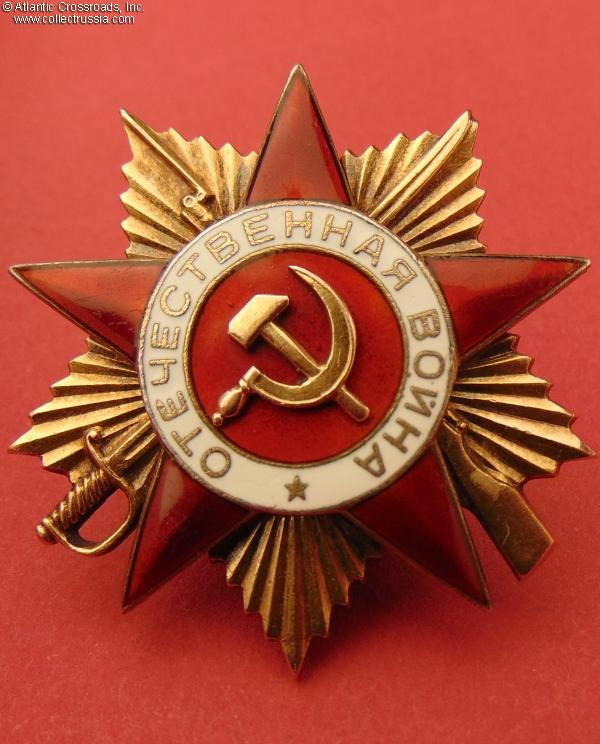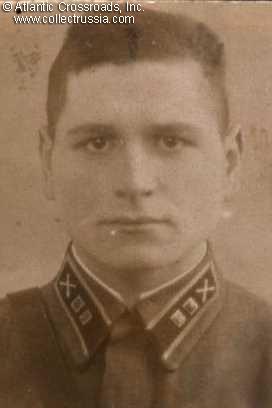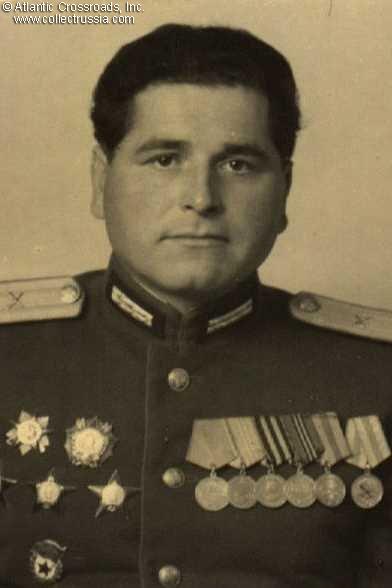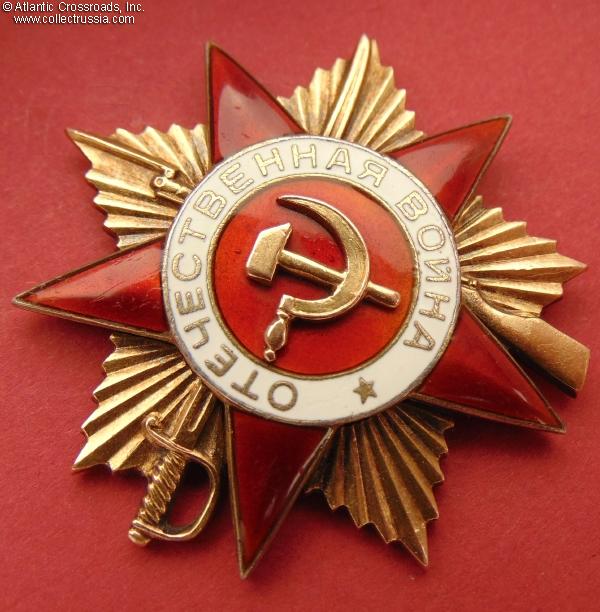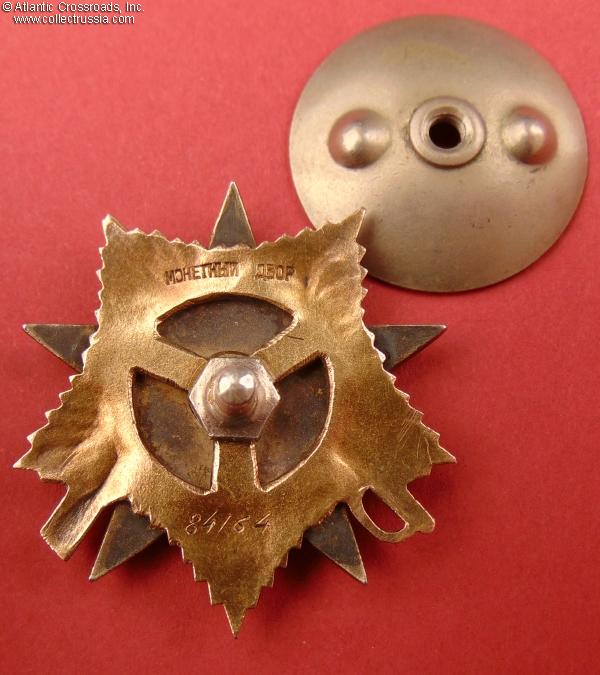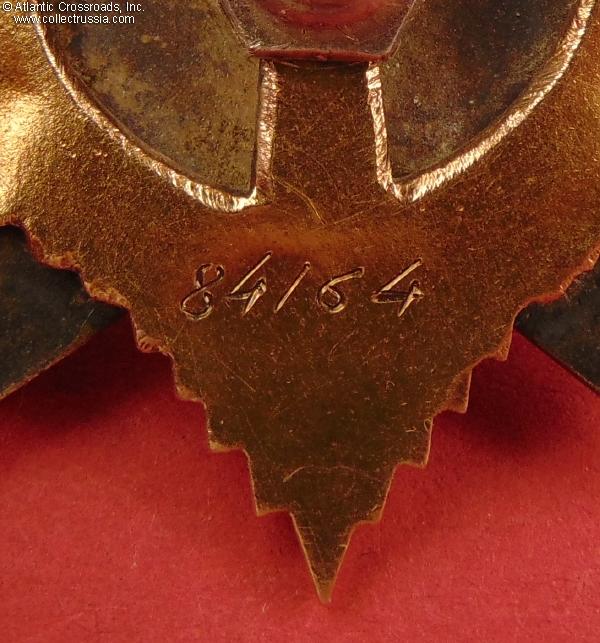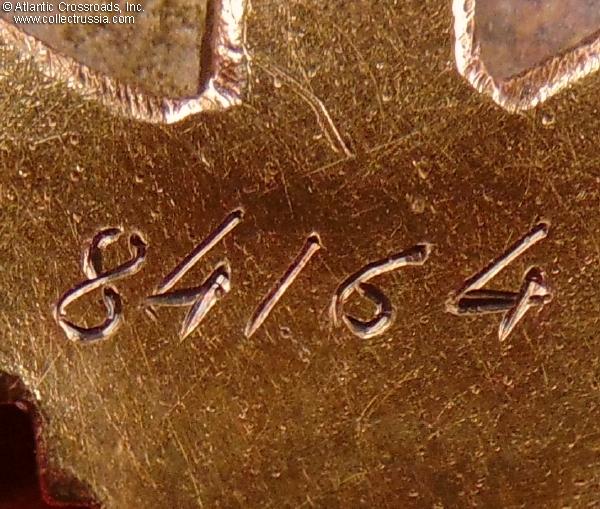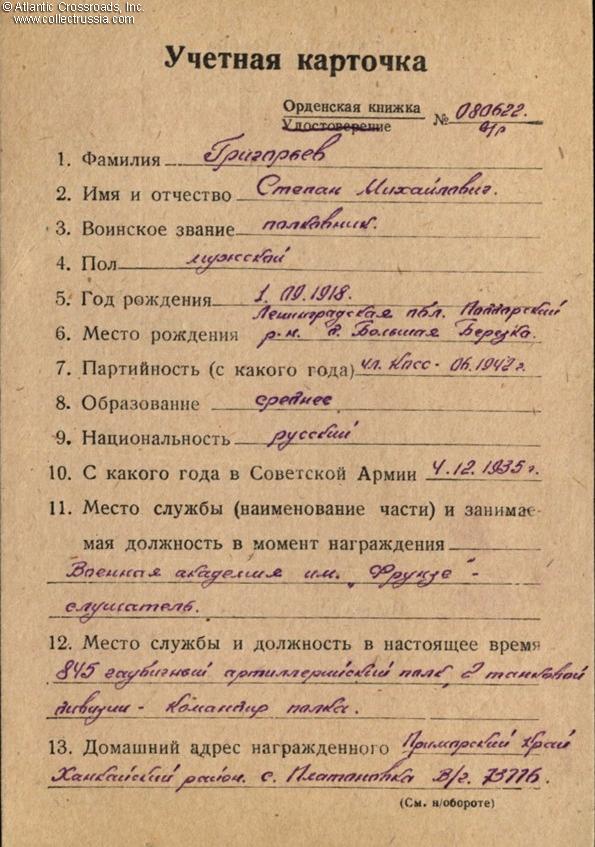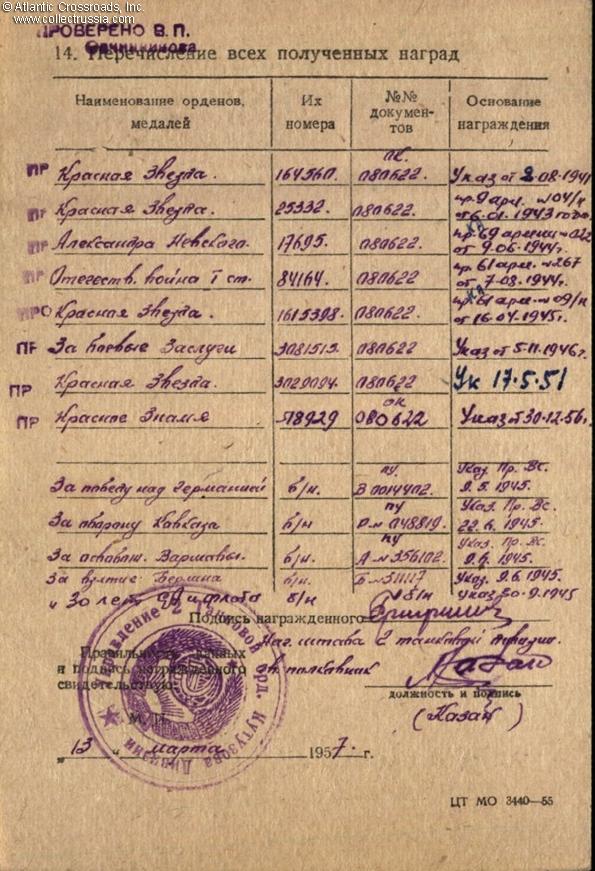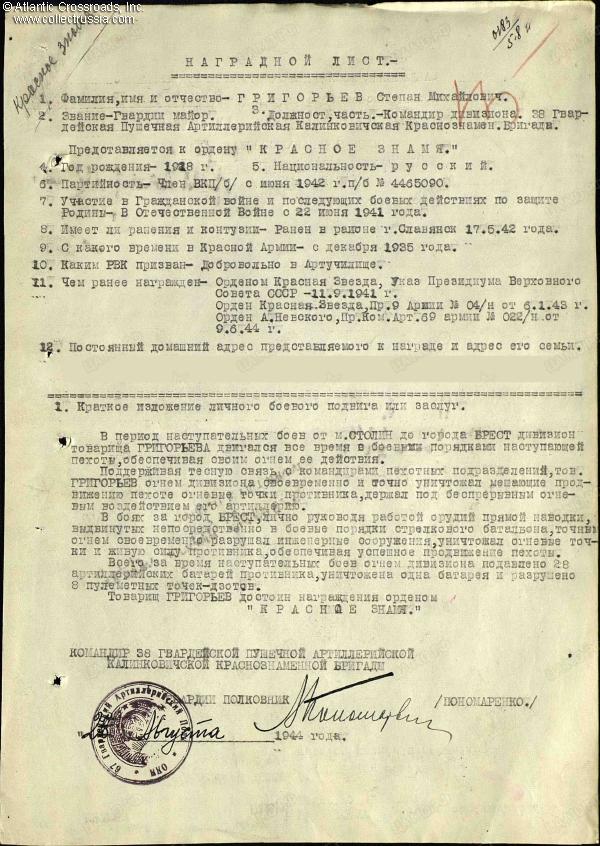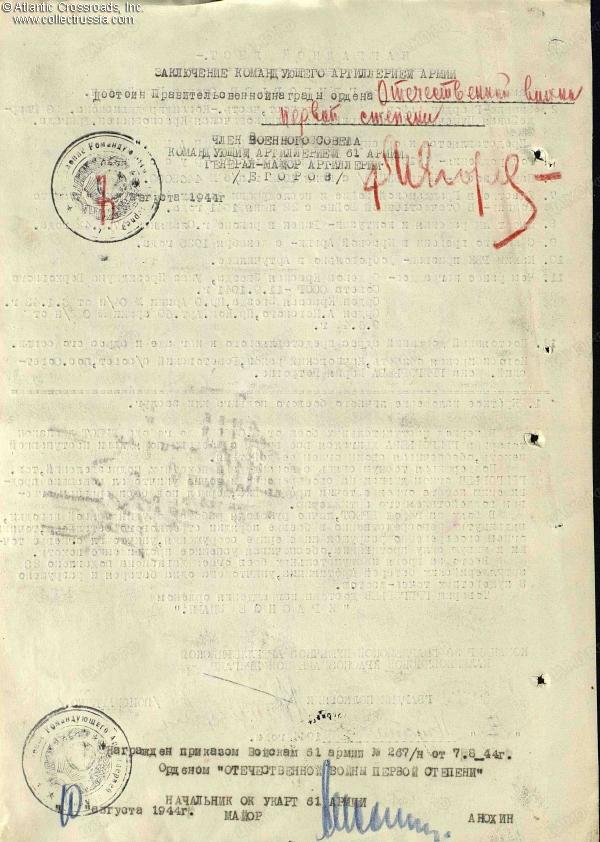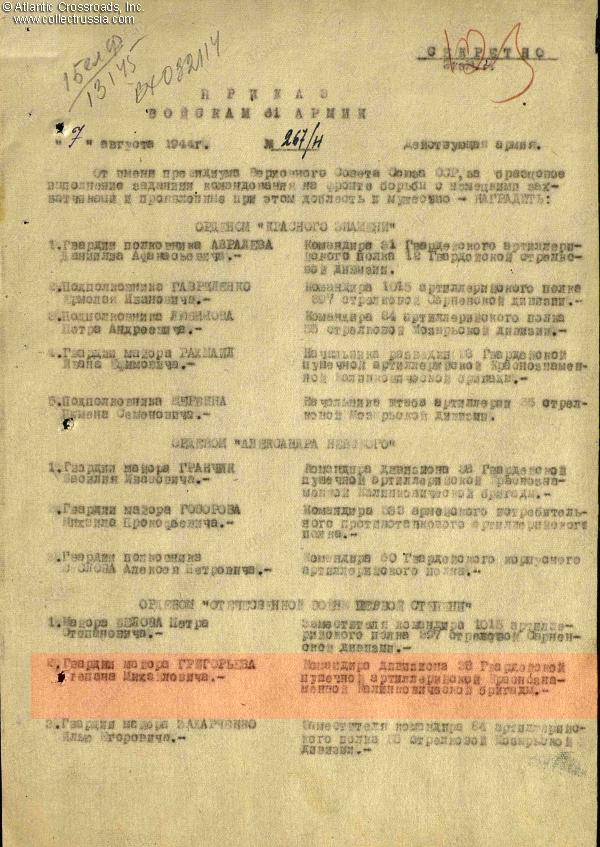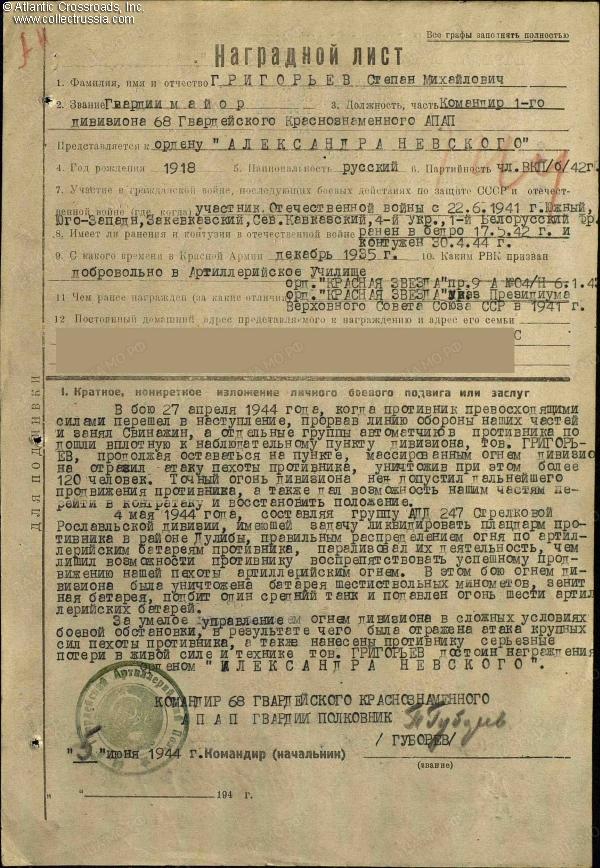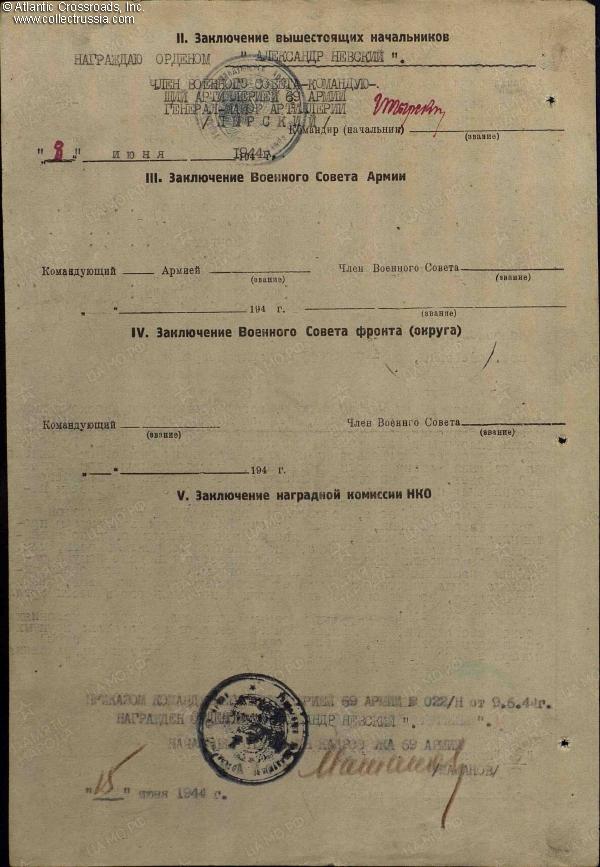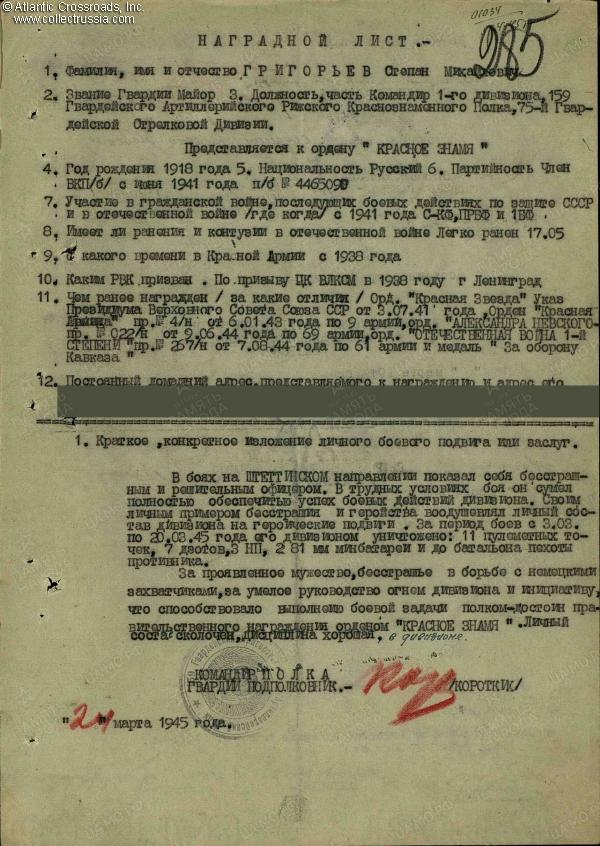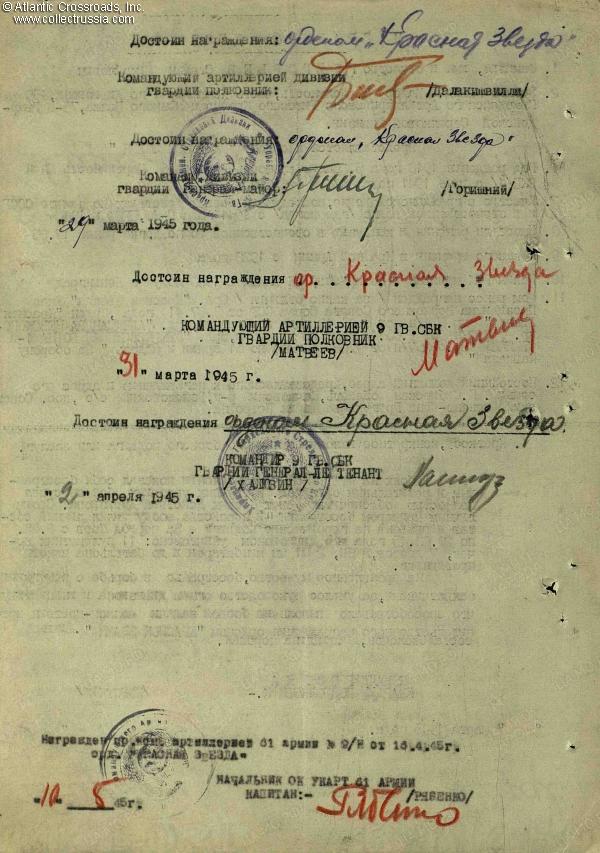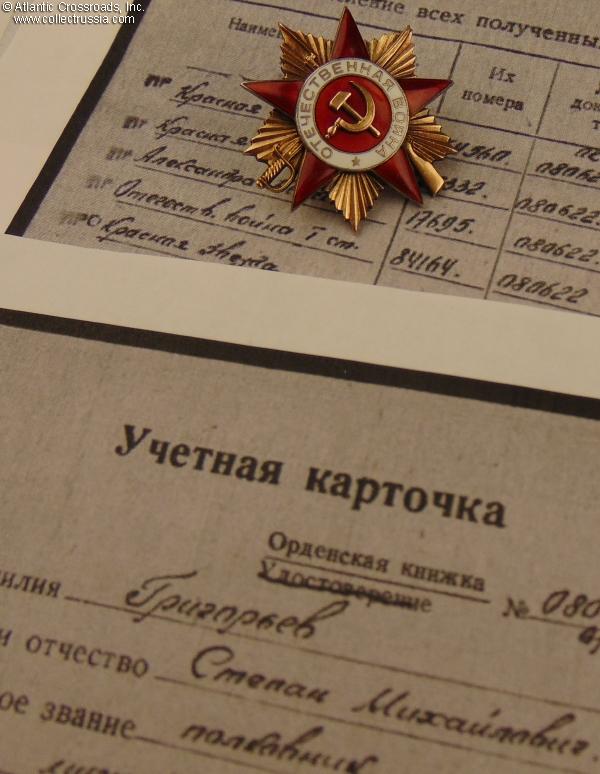
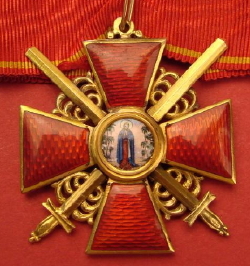
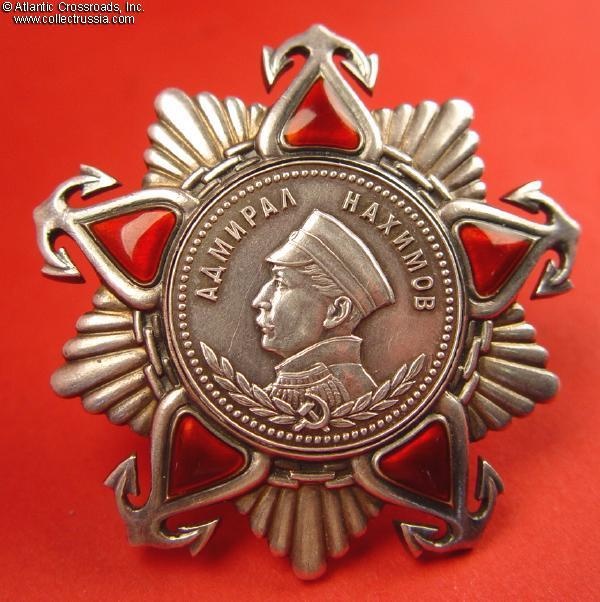
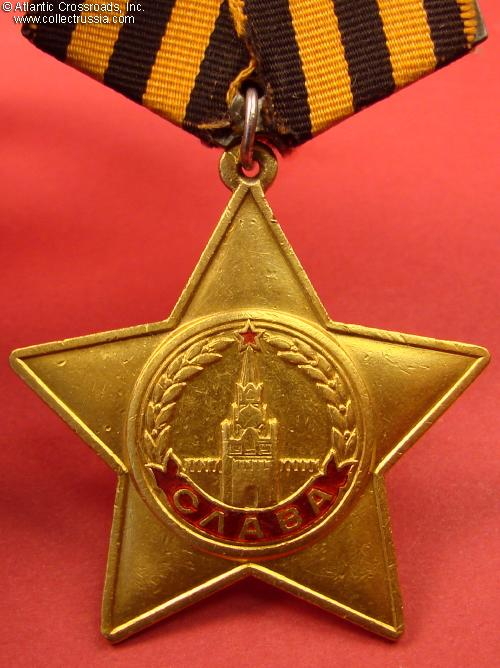
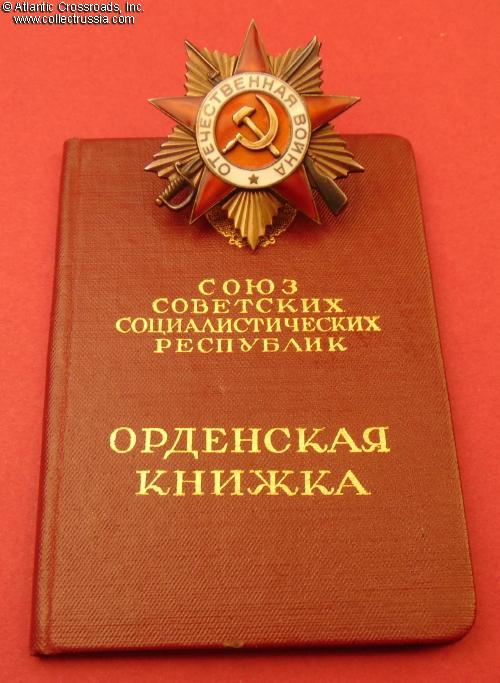
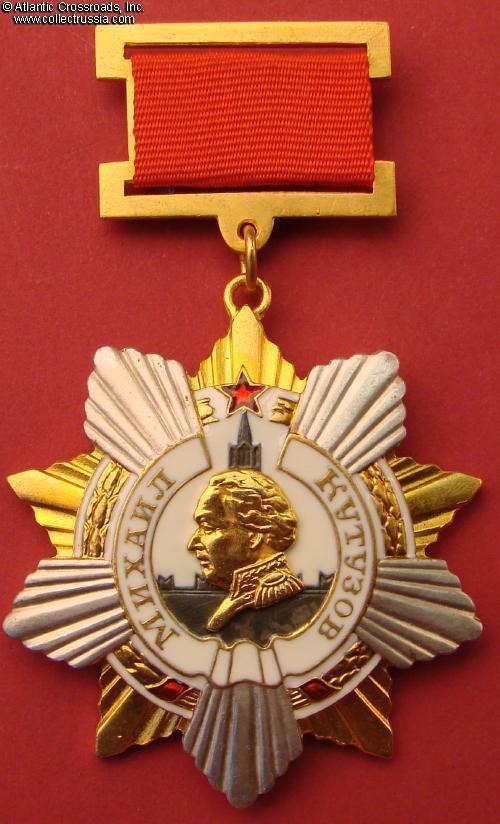





Order of the Patriotic War, 1st class, Type 2 Variation 1, #84164, awarded on 7 August 1944 to Guards Major Stepan Grigoryev (Степан Михайлович Григорьев), battalion commander in the 68th Heavy Artillery Regiment, Reserves of the Supreme Command.
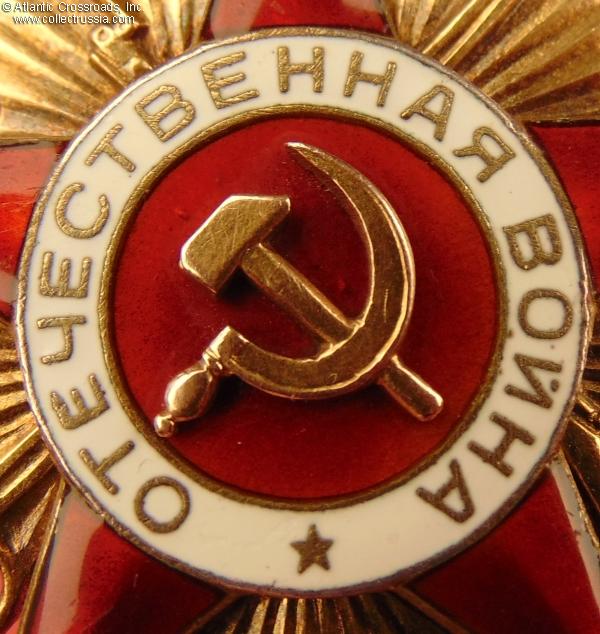
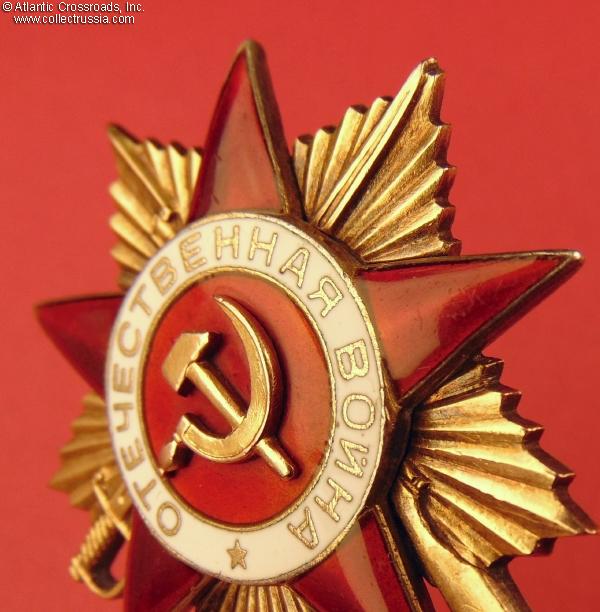
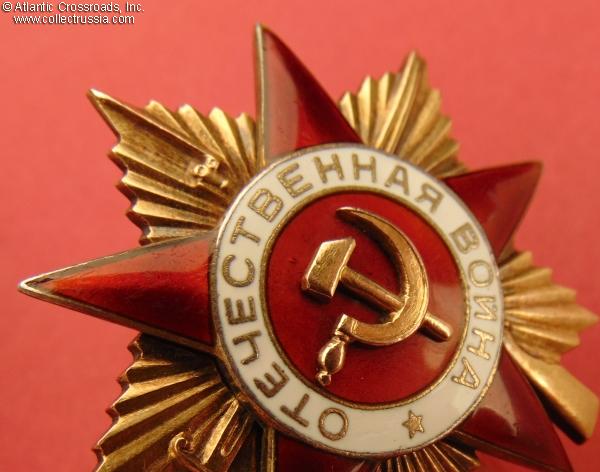
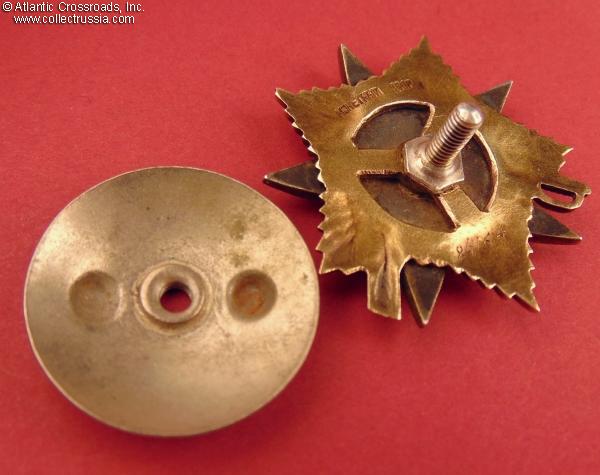
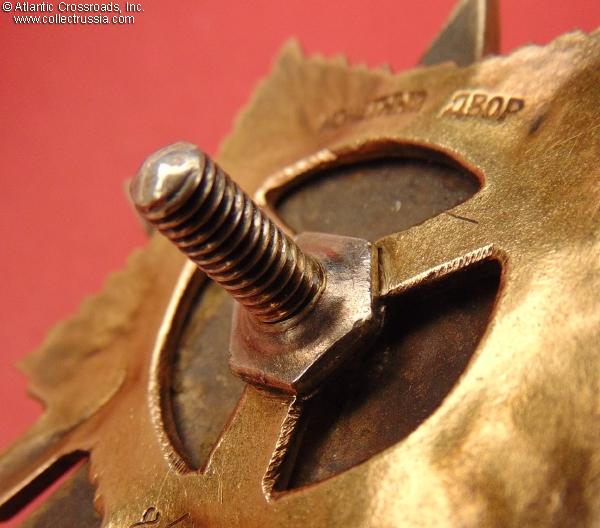
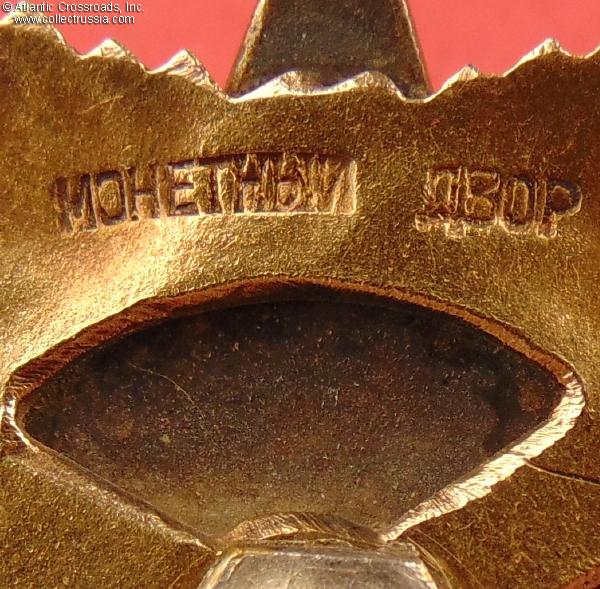
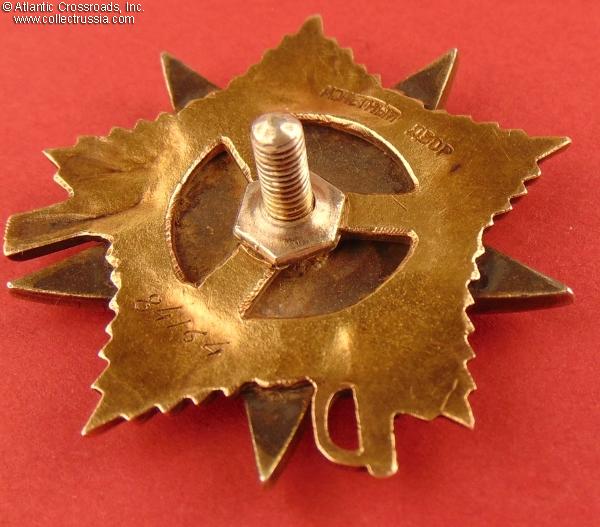
Solid 14 K gold (starburst, hammer & sickle emblem), silver and enamels. Measures 45.6 mm in height, 43.5 mm in width; weighs 36.4 g without the screw plate. Relatively scarce early issue with a single-line, slightly arched mint mark. Note the five-digit serial number, which is quite low for the Type 2.
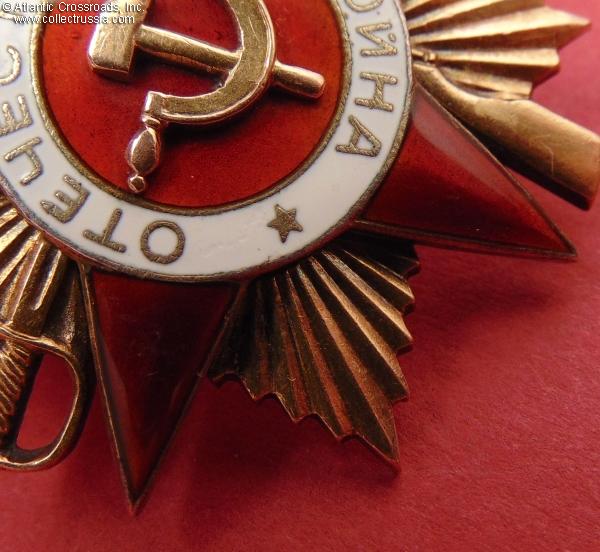
In very fine condition. The red enamel has tiny, nearly unnoticeable surface flakes at the tips of the top, upper left and lower left arms. There are also numerous minuscule contact marks on the arms and the white band. Nevertheless, all the wear is barely noticeable to the unaided eye; the enamel retains a nice luster throughout and presents very nicely overall. The red enamel in the center is perfect.
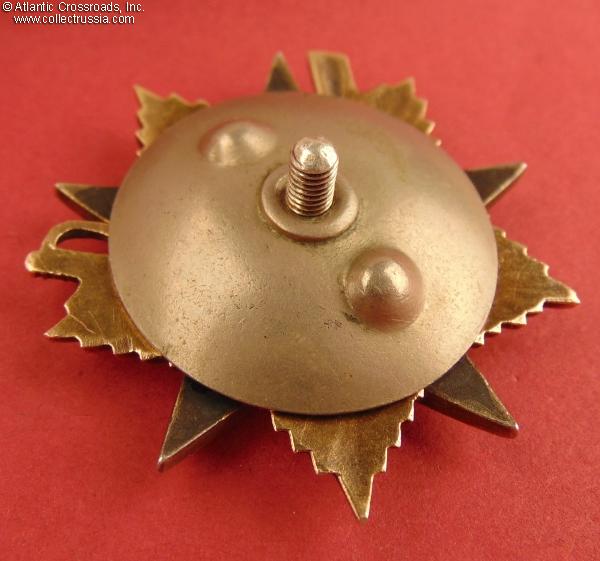
The details of the golden starburst and the hammer & sickle emblem are beautifully preserved and crisp, having only a couple of tiny dings and no significant wear. There is very nice untouched toning to the gold throughout and dark patina on the reverse of the silver star. The screw post is full length, approx. 14 mm long measured from the silver star, and includes an original wartime screw plate. To summarize, this piece is free of any glaring flaws, a very attractive example of the Order of the Patriotic War 1st cl.
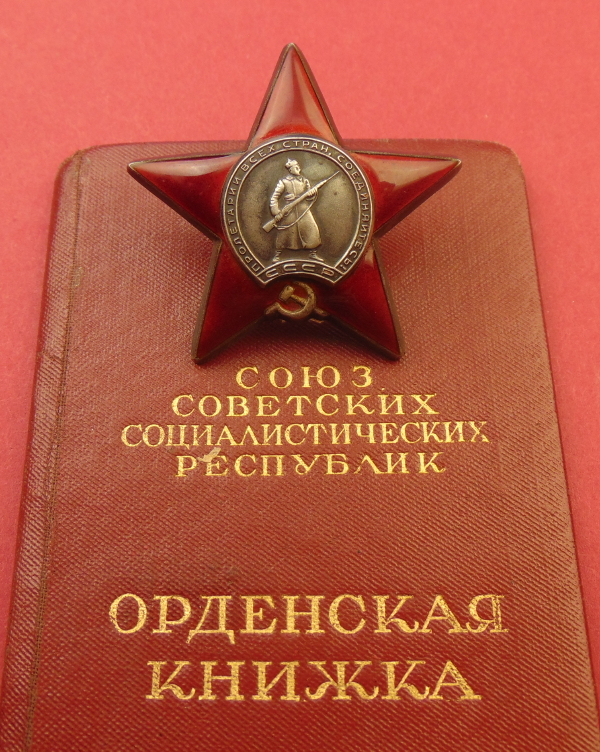
Stepan Grigoryev was born in 1918 in a village in the Leningrad (then Petrograd) region. In 1935, he was admitted to the Leningrad Artillery School and became a commissioned officer upon graduation. In 1939, he took part in the Soviet annexation of northeastern Poland (referred to as "liberation of Western Belorussia" by the Soviets). He was on the front lines since the first day of the Patriotic War on 22 June 1941 and immediately distinguished himself in combat. On 2 August 1941, Grigoryev was awarded with the Order of the Red Star, a rare occurrence in the early days of that war (unfortunately, the award commendation for this decoration could not be found in the archives, as if often the case with very early awards.)
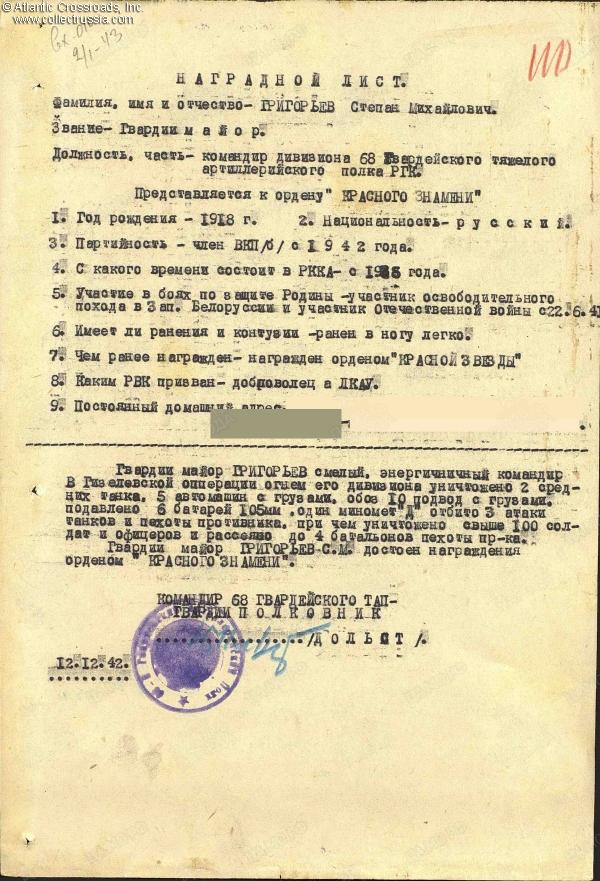
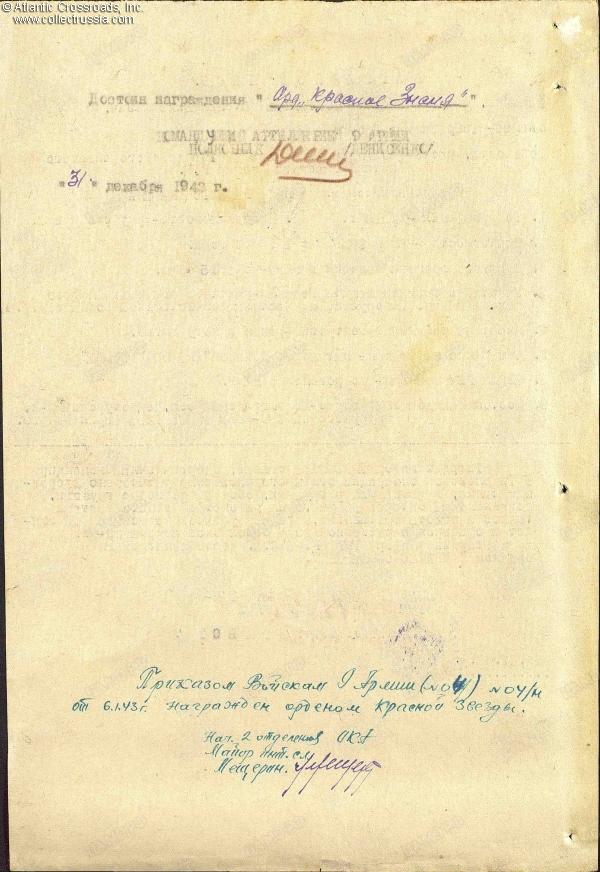
During the first year of the war, Grigoriev served as an artillery squadron commander with the Southern, Southwestern, and Transcaucasian Fronts, was wounded in combat in May 1942 near the town of Slavyansk and in the fall of that year took part in defending the Baku oil fields. He greatly distinguished himself in the decisive November 1942 battle at the North Ossetian village of Gizel near the city of Ordzhonekidze (now Vladikavkaz) when the Soviet Transcaucasian Front counterattacked and brought the German movement through the mountain passes to a screeching halt. His squadron destroyed two enemy tanks, five trucks and ten horse-drawn carriages with their cargo, and damaged five 105-mm guns and one mortar. They also repelled three attacks of infantry and tanks, eliminating over 100 enemy soldiers and scattering up to four infantry battalions. For these actions, the commander of the 68th Guards Heavy Artillery Regiment recommended Grigoryev, then already a Guards Major, for the Order of the Red Banner. Commander of the Artillery of the 9th Army to which the 68th was subordinated at the time approved the recommendation. However, the 9th Army command downgraded it to the Order of the Red Star, Grigoriev's second of the war, which was awarded on 6 January 1943.
By late April 1944, the 68th Guards Artillery Regiment had been resubordinated to 69th Army, 1st Belorussian Front. At that time, it was engaged in heavy defensive battles in the Volyn Region of western Ukraine. Grigoryev showed outstanding bravery on 27 April, when the enemy broke through near the village of Svinazhin and German submachine gunner groups reached his squadron's observation post. At this critical moment, Grigoryev remained at his post, correcting the squadron's artillery fire. Thanks to his valor and presence of mind, the squadron's fire repelled the enemy infantry, killing over 120 of them and allowing the Soviet infantry to counterattack and retake their original positions. Grigoryev's squadron performed exceptionally well on 4 May when it supported the 247th Rifle Division, 61st Rifle Corps, in their attack to liquidate an enemy position near the village of Duliby. In this battle, Grigoryev and his men liquidated a battery of Nebelwerfer rocket launchers (referred to as "six-barrel mortars" in the subsequent award commendation) and an antiaircraft battery, damaged a German tank, and neutralized six artillery pieces. For his personal bravery and outstanding results, Grigoryev was recommended for the Order of Alexander Nevsky, which was bestowed upon him on 9 June 1944 (#17695).
During Operation Bagration, a strategic Soviet offensive in Belorussia that largely destroyed German Army Group Center, Grigoryev served as a squadron commander with the 38th Guards Artillery Brigade, 69th Army. During the 80-mile westward advance from the Belorussian town of Stolin to the city of Brest near the Soviet post-1939 national border, his squadron constantly supported the forward lines of the attacking infantry with direct fire. In the battle for Brest his men, firing over open sights, relentlessly pulverized enemy defenses, destroying reinforced weapon emplacements, leveling buildings, and killing numerous enemy soldiers. Throughout the offensive, the squadron's total tally was 28 neutralized artillery batteries, one destroyed artillery battery, and eight demolished pillboxes. Commander of the 38th Guards Artillery Brigade recommended Guards Major Grigoryev for the Order of the Red Banner. It was downgraded up the chain of command to the Order of the Patriotic War 1st cl., which was awarded on 7 August 1944.
By March 1945, Grigoryev had been reassigned as a squadron commander to the 159th Artillery Regiment, 75th Guards Rifle Division, 9th Guards Rifle Corps, 61st Army, 1st Belorussian Front. Fighting against the German Army Group Vistula near the city of Stettin (modern-day Szczecin, Poland) at the estuary of the Oder, Grigoryev's battalion showed outstanding results in combat. From 3 - 20 March 1945, it destroyed 11 machine gun nests, seven pillboxes, three observation posts, two 81-mm mortar batteries and up to a battalion of German infantry. For building and leading such an efficient combat team, Guards Major Grigoryev was recommended for the Order of the Red Banner. This recommendation was downgraded?the third time his recommended award had been reduced?to the Order of the Red Star, which he received on 16 April 1945. This was his last combat decoration and the third Order of the Red Star.
Grigoryev's military career did not end with the end of the war. Besides WW2 combat decorations, his award record card shows a Medal for Combat Service (Nov. 1946), Order of the Red Star (May 1951) and Order of the Red Banner (Dec. 1956) awarded for length of service. As of March 1957, when the award card was filled in, Stepan Grigoryev had the rank of Colonel and served as the commander of the 845th Artillery Regiment, 2nd Tank Division, located on the border with China, about 80 miles north of Vladivostok. Based on the information found on Russian archival website Pamyat-naroda.ru, he retired in 1973 after nearly 38 years of service in the military.
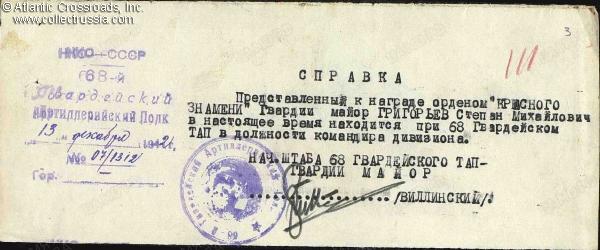
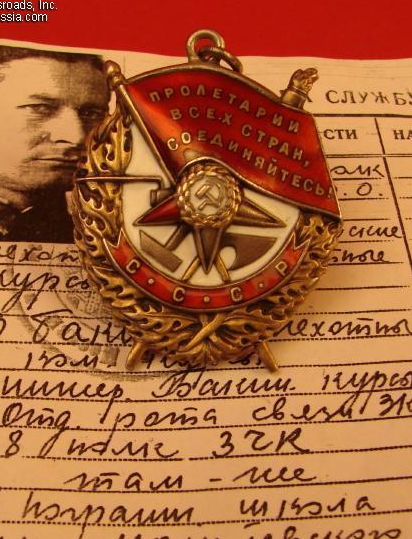
Research Materials: b/w photocopy of the award card, commendations for the Order of the Patriotic War, 1st cl. and three other WW2 decorations, and the relevant part of the award decree for the Order of the Patriotic War 1st cl.
Item# 47181
$1,650.00 Add to cart