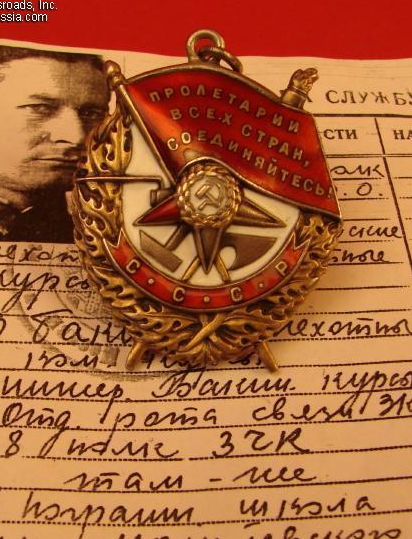
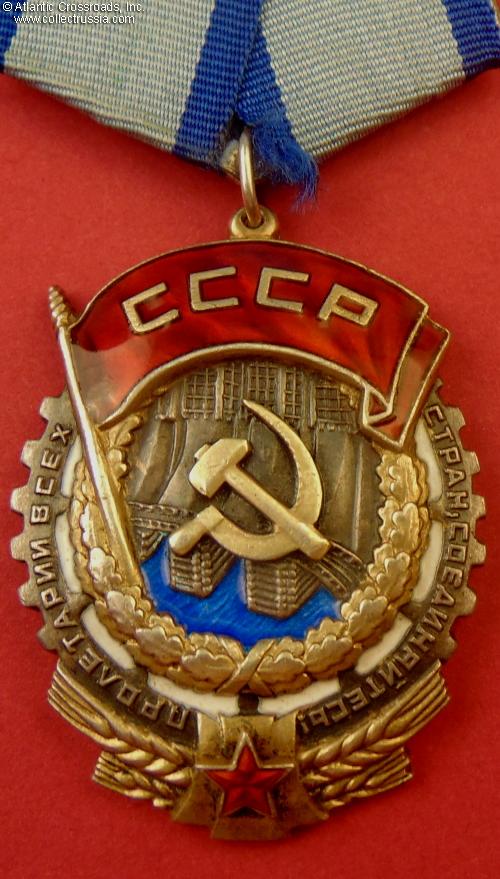
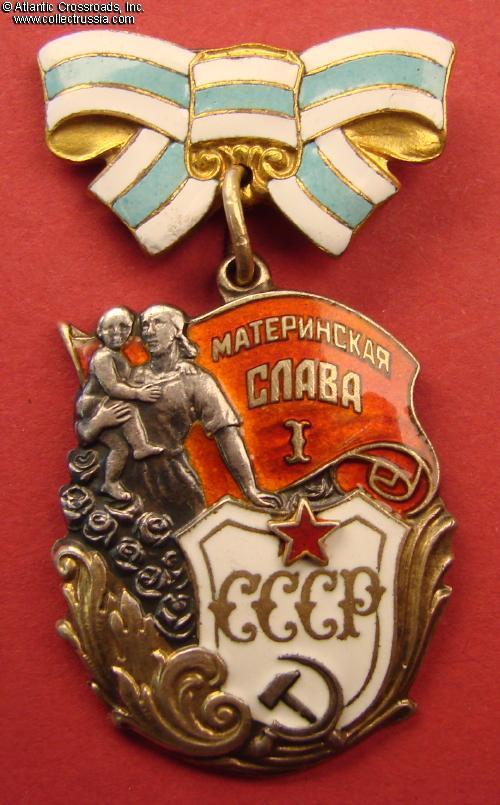
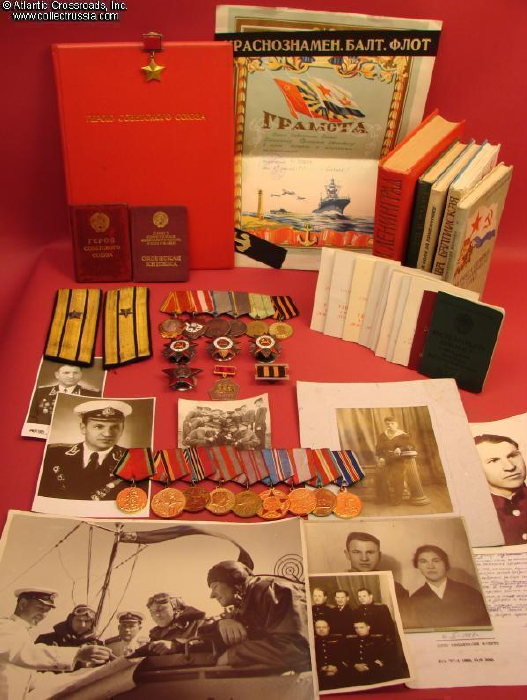
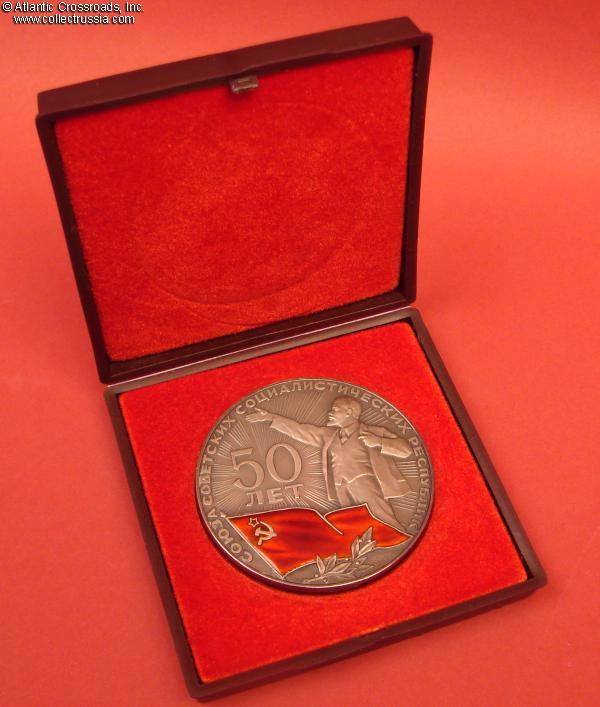
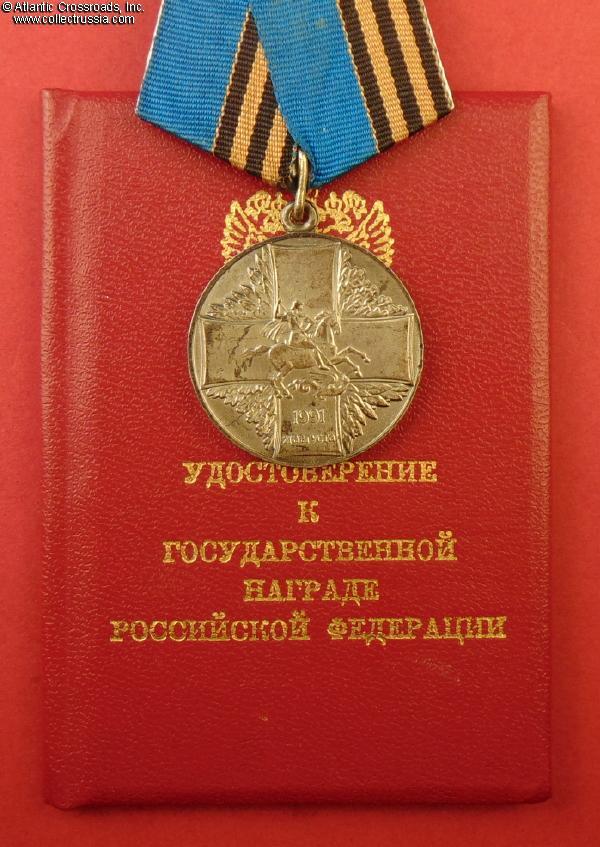



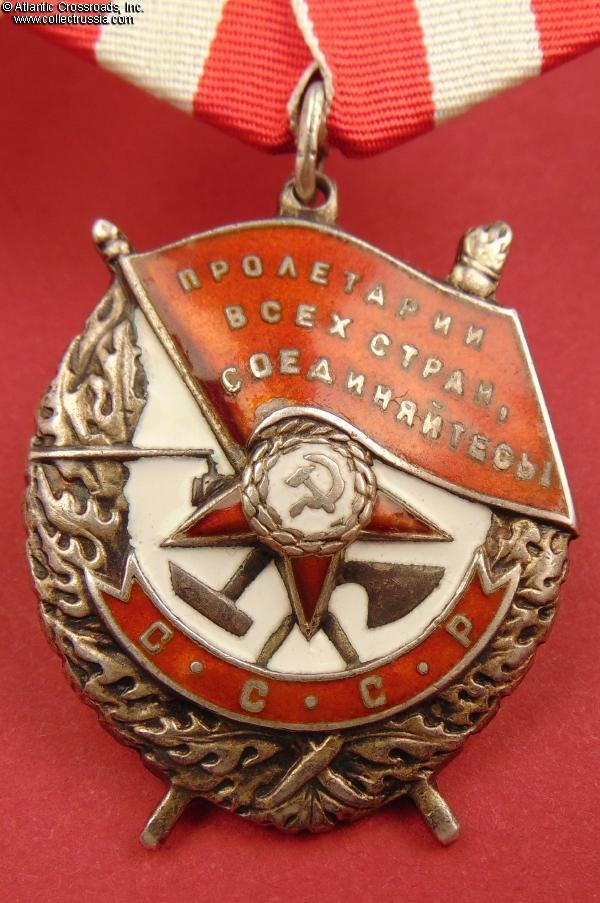
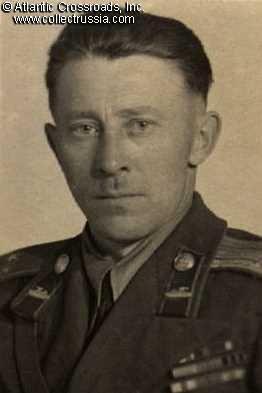
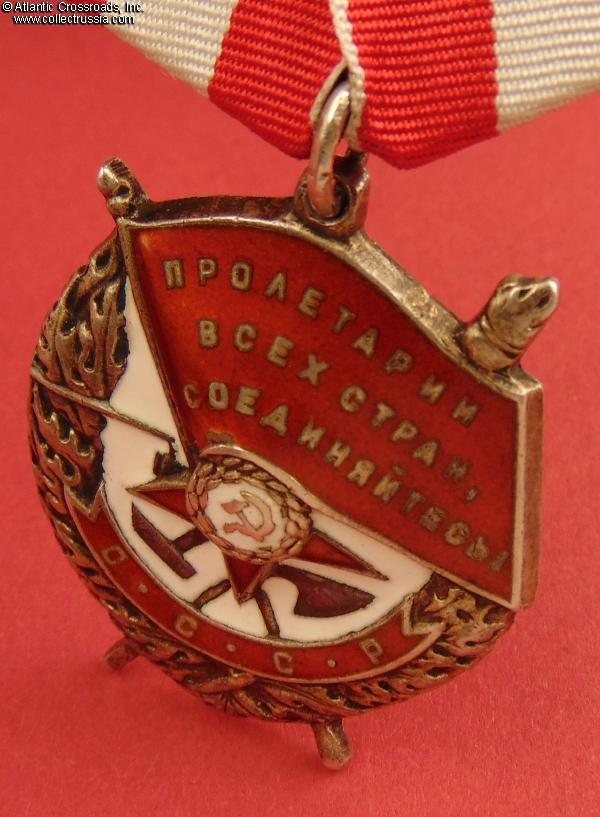
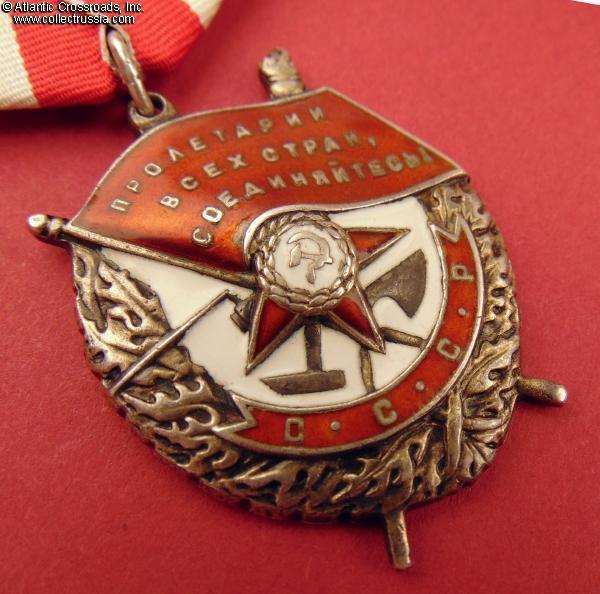

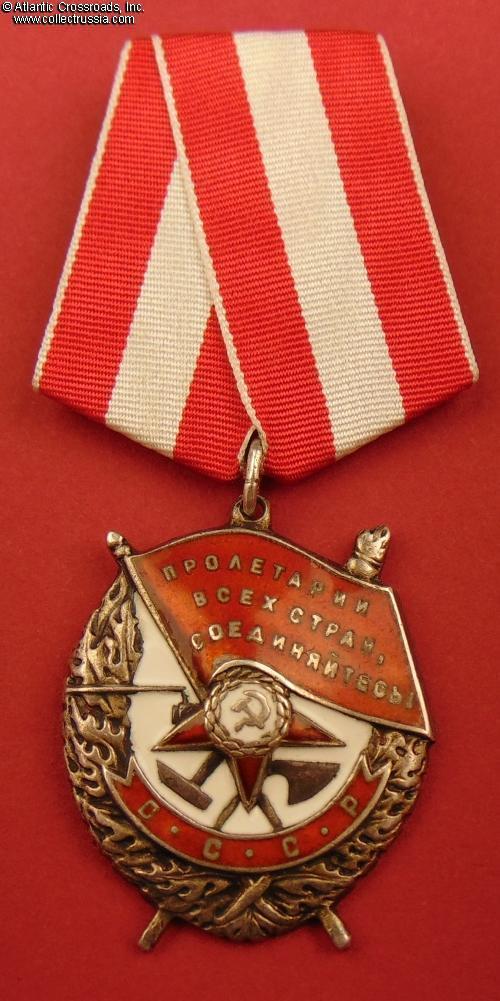
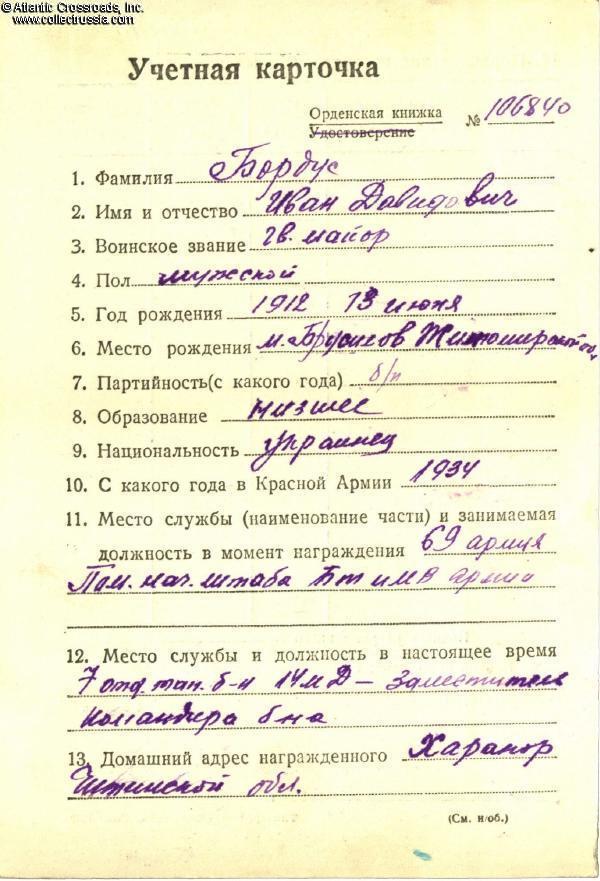

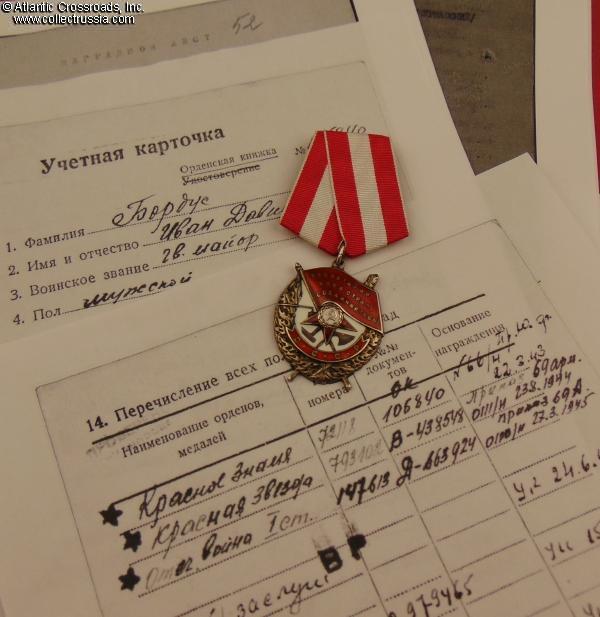
Order of the Red Banner, Type 4, Variation 2, Sub-variation 3, #72118, official replacement for a Type 2 screw back awarded on 23 March 1943 to Senior Lieutenant Ivan Bordus (Иван Давыдович Бордус), Senior Adjutant of the 3rd Heavy Tank Battalion, 3rd Guards Heavy Tank Brigade, 7th Guards Tank Corps, Southern (formerly Stalingrad) Front.
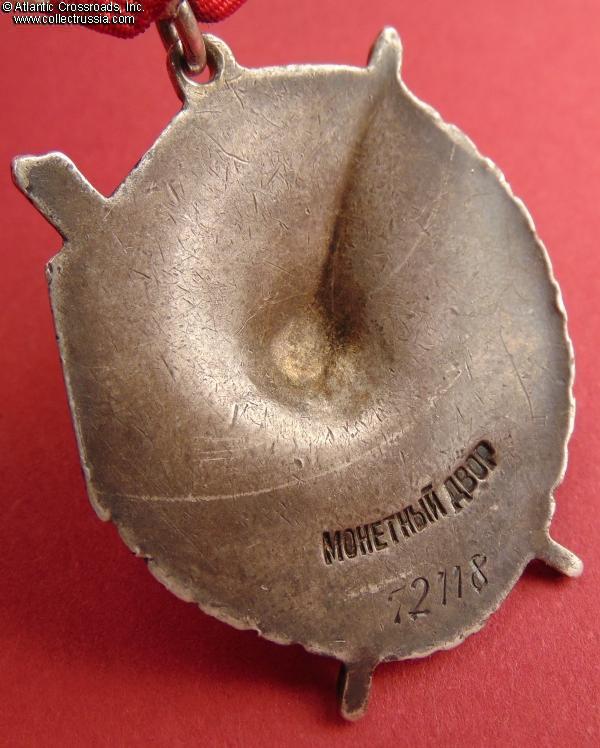
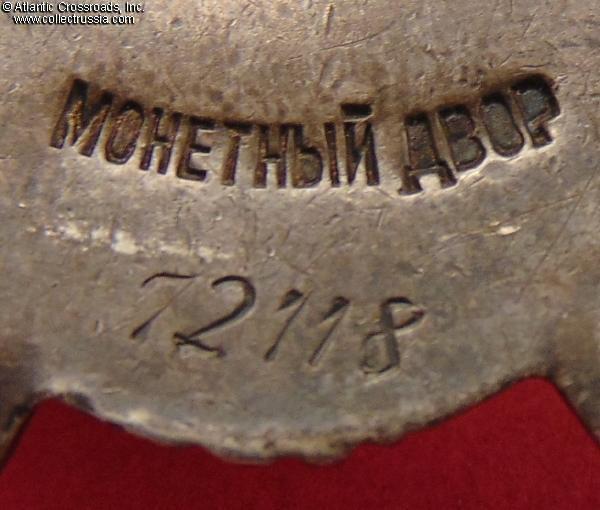
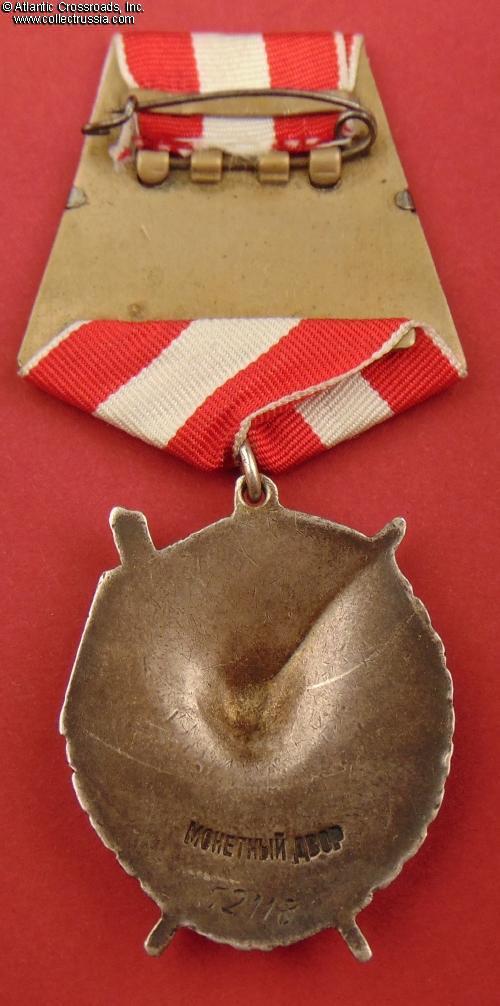
Silver gilt, enamels; measures 45.7 mm in height (incl. eyelet and lower projections of the torch and flagpole), 37.5 mm in width; weighs 25.4 g not including the suspension and connecting link. Features smooth reverse with circular depression in the middle. The mint mark is in relatively large font, with a straight dash over the last character in the word "Monetnyi" (Type 3, Var. 2 according to McDaniel classification).
Judging by its mint mark and other characteristics, this piece is from the series with the "normal" serial number range of approximately 203,600 - 270,000
Silver gilt, enamels; measures 45.7 mm in height (incl. eyelet and lower projections of the torch and flagpole), 37.5 mm in width; weighs 25.4 g not including the suspension and connecting link. Features smooth reverse with circular depression in the middle. The mint mark is in relatively large font, with a straight dash over the last character in the word "Monetnyi" (Type 3, Var. 2 according to McDaniel classification).
Judging by its mint mark and other characteristics, this piece is from the series with the "normal" serial number range of approximately 203,600 - 270,000 manufactured in 1945 by the Moscow Mint. Unlike many other wartime / early post-war reissues, there are no signs of serial number alteration: this specimen came from the unnumbered stock set aside at the mint specifically to issue in exchange for the earlier screw backs. Most likely early candidates for mint reissues were participants of the 1945 Victory Parade in Moscow who were required to wear awards of the latest type and thus have a "uniform" look. Any "Victory Parade" mint reissues without a serial number alteration are very scarce. Moreover, most of them are Type 4 Variation 1, whereas only a very small minority are Variation 2, making this piece particularly rare.
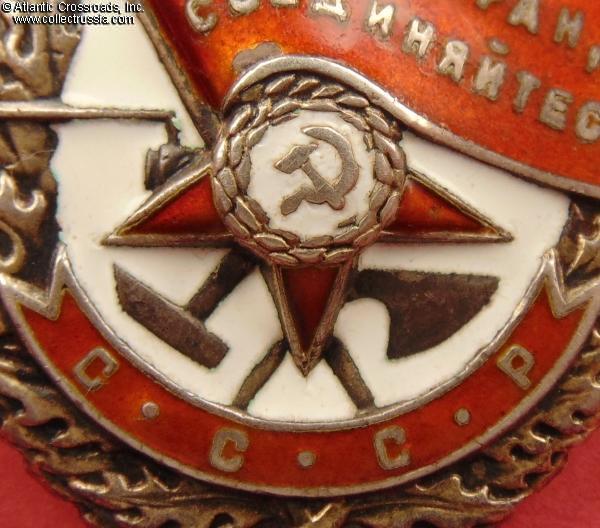
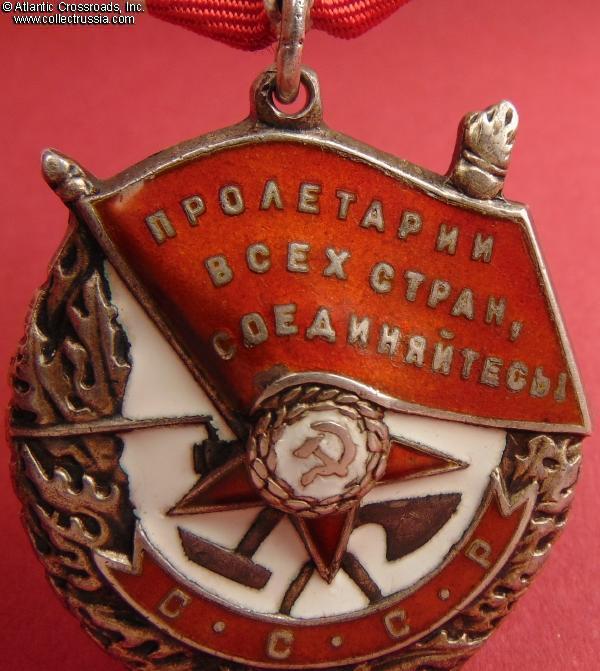
The order is in very fine condition, very respectable for a WW2 issue. The enamel is generally well-preserved. There is a single small chip to the red enamel on the banner just above the center star which is not too detractive. The banner also has some very tiny flakes along the edges and minuscule contact marks throughout, all of them nearly unnoticeable to the naked eye. The red enamel on the star has a couple of surface flakes on the left arm and a few microscopic contact marks elsewhere, otherwise intact. The red plaque with "CCCP" also has a few tiny flakes along the edges, practically invisible without magnification. The white enamel has a tiny amount of wear in the center, otherwise perfect.
The details of both the wreath around the central medallion and outer wreath are well-preserved and crisp, while the upper part of the torch shows a moderate amount of wear. Some of the original gilt finish, albeit pale, is still visible in recessed areas of the wreath. The reverse is nearly pristine and exhibits a very attractive even patina to silver. The order comes on an original suspension, a WW2 two-layer model in steel with a self-locking pin. The ribbon is new. The connecting link appears to be original, and its ends are still joined with solder.
To summarize, despite some minor wear to the enamel, an overall attractive decoration free of any glaring flaws.
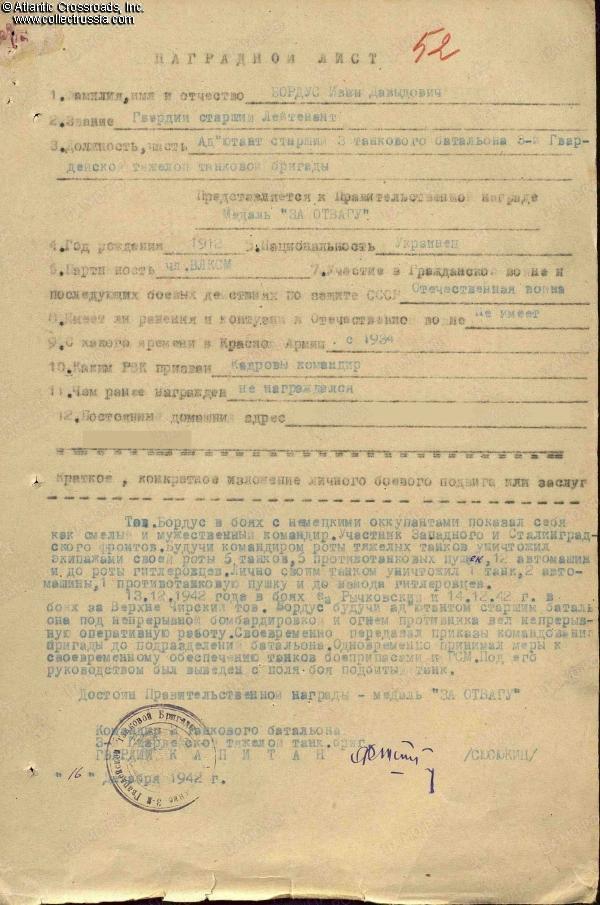
Ivan Bordus was born in 1912 in a small settlement in Zhitomir district of the Volyn Province of the Russian Empire, modern-day Ukraine. He joined the Red Army in 1934 and became a cadre officer. He fought on the front lines of the Patriotic War almost from the start, from 1 July 1941. In the early period of the war Bordus served with the Western Front and later, with the Stalingrad Front as a KV heavy tank company commander. He and his tank crew were credited with destroying an enemy tank, two motor vehicles, an antitank gun, and up to a platoon of enemy soldiers, while the company he commanded destroyed a total of five enemy tanks, six antitank guns, and 12 trucks, and eliminated up to a company of enemy soldiers.
By December 1942, Bordus had been promoted to Senior Adjutant of the 2nd Tank Battalion, 3rd Guards Heavy Tank Brigade, 7th Tank Corps, Stalingrad Front. In this capacity, he took part in some of the most pivotal fighting of the second phase of the Battle of Stalingrad - the repelling of Field Marshal Erich von Manstein's relief attempt during the course of the German operation Wintergewitter. In the first days of December, the German relief force had been making a steady if not decisive progress westward towards the Stalingrad pocket, repelling several Soviet counterstrikes. By December 7th, Manstein's panzers had defeated the Soviet 5th Tank Army and virtually annihilated the 1st Tank Corps standing in their way, and had reached the Chir River line.
As the situation grew critical, a new ad-hoc Soviet army dubbed 5th Shock Army was created and thrown into the fray, with its armored forces consisting of the 23rd and 7th Tank Corps. The latter was led by the very capable tank commander Maj. Gen. Pavel Rotmistrov who had received high acclaim as a brigade commander in the Battle of Moscow. The immediate objective was to meet the enemy force head-on and recapture the areas near the villages of Rychkovskiy and Nizhne-Chriskaya located between the Chir and Don Rivers southeast of Kalach, and thus deny the Germans the only direct path to Stalingrad.
On the morning of 12 December, the German panzers jumped off and Operation Wintergewitter ("Winter Storm") was underway. Although only a portion of the originally planned German forces took part in it - due in part to incessant Soviet attacks elsewhere and in part poorly prepared Luftwaffe field divisions slated for the counter-offensive - Manstein counted on at least a limited success, hoping that Hitler would order a simultaneous breakout of the Paulus' VI Army trapped in Stalingrad (planned Operation Donnerschlag). On the following day, the German LVII Panzer Corps reached the Aksay River and captured a bridge. It was however got bogged down on the Chir River by the fierce counterattacks of the 5th Shock Army which included the 7th Tank Corps and Bordus' heavy tank battalion. On 12-13 December, Bordus showed personal bravery and skills in the heavy fighting that unfolded first near Rychkovskiy and then at Nizhne-Chirskaya in what was perhaps the most pivotal moment of the entire battle. Under an incessant aerial bombardment and ground fire, Bordus showed outstanding operational support, relaying the command's directives in a timely manner and keeping the tanks supplied with fuel and ammunition. As one of the tanks was disabled, Bordus led a rescue operation and succeeded in towing the tank from the battlefield.
The bravery and resolve of the men of the 5th Shock Army such as Bordus and his tankers completely frustrated the German relief attempt. As early as on 12 December, Manstein realized that the LVII Panzer Corps could not make a breakthrough on the Chir and urgently requested reinforcements from Hitler. Even with the addition of the German 17th Panzer Division however, the German offensive effort went nowhere and on 14 December, a part of their bridgehead on the east bank of the Don near Chir had to be evacuated. In the following days, the Wintergewitter failed completely; as Hitler vacillated, never issuing the much-awaited order for the breakout from the pocket, any chances of escape for Paulus' forces in Stalingrad were lost for good.
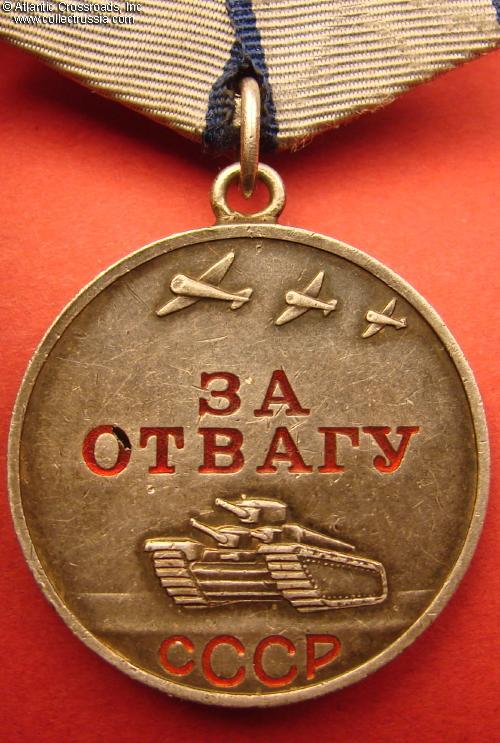
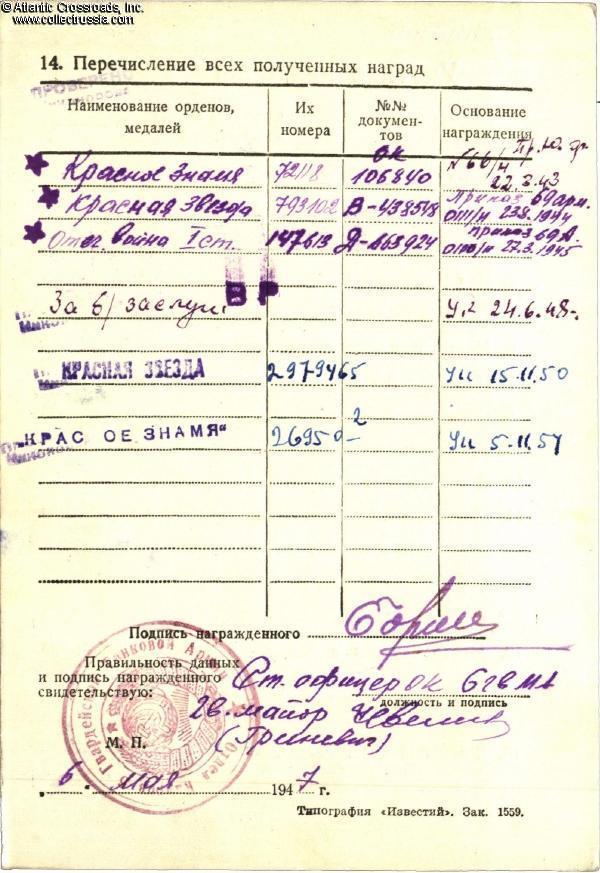
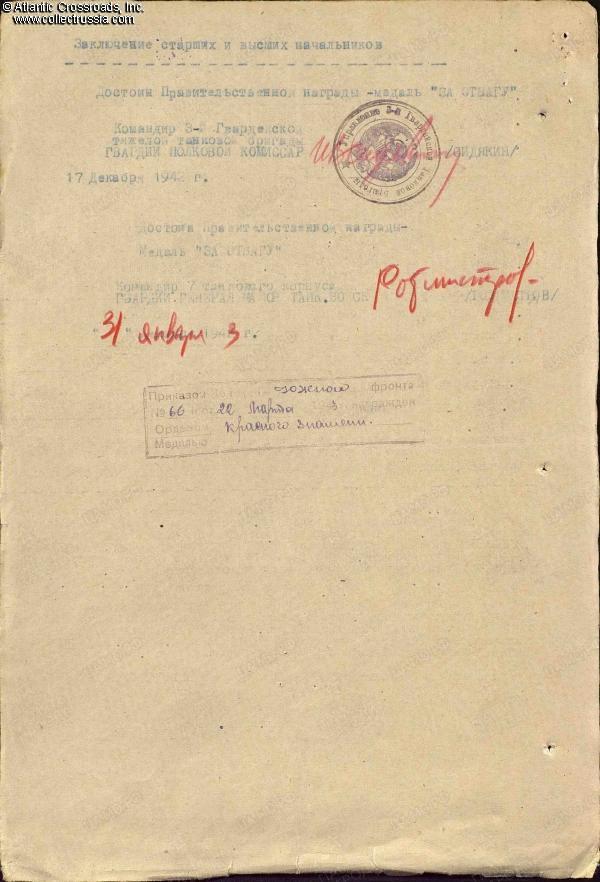
On 16 December, the commander of the 3rd Tank Battalion recommended Bordus for the Medal for Valor in recognition of his leadership and bravery at Rychkovskiy and Nizhne-Chirskaya as well as the earlier part of the Battle of Stalingrad. The medal would be an unusual decoration for an officer - more of a frontline enlisted soldier's award - but on 31 January it was upgraded to the Order of the Red Banner personally by Gen. Rotmistrov. The decoration was officially bestowed upon Bordus with a significant delay on 22 March 1943 by a general order of the Southern (formerly Stalingrad) Front. It must be said that for its exceptional role in the Battle of Stalingrad and specifically at Kotelnikovo in December 1942, the 7th Tank Corps was given an honorific title of Kotelnikovskiy and elevated to a Guards unit, becoming the 3rd Guards Tank Corps. At the same time, Rotmistrov was promoted to Lieutenant General and was awarded with the Order of Suvorov, 2nd cl. (one of the first such awards ever issued.)
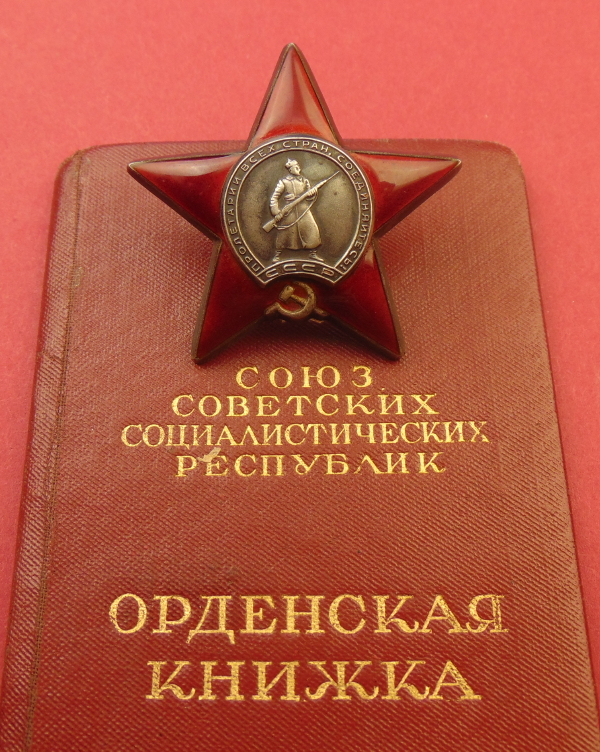
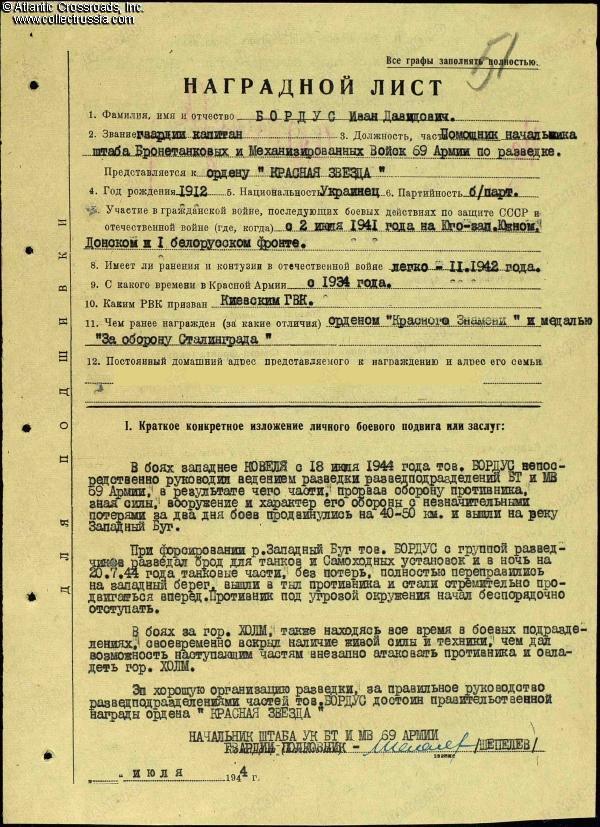
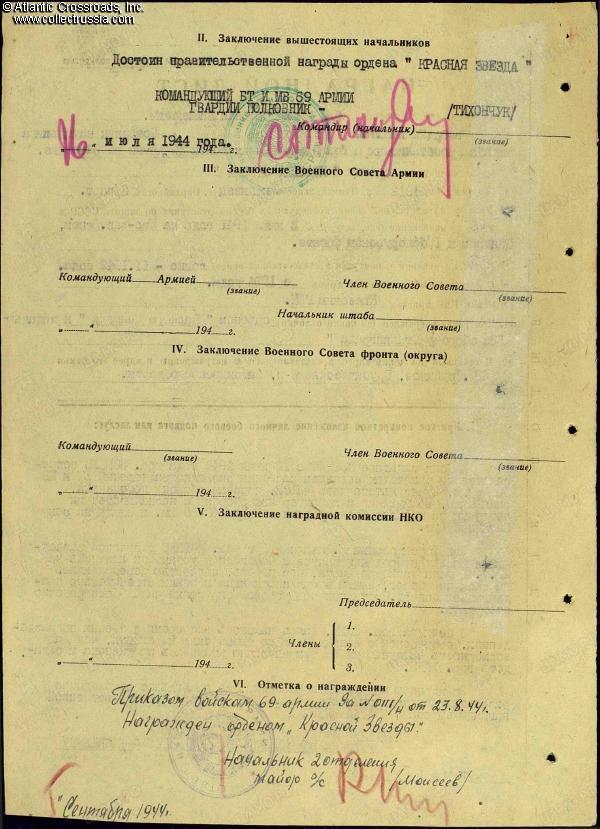
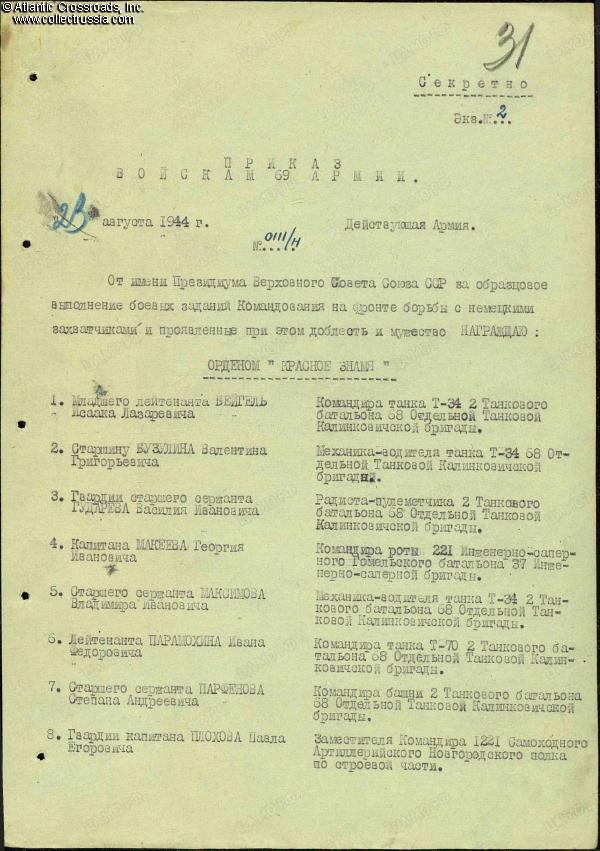
The Order of the Red Banner was the first but not the last of Bordus' combat decorations. In June 1944, he had the rank of Captain and served in the position of Deputy Chief of Staff of the Armored and Mechanized Forces of the 69th Army, Reconnaissance. In this role, he led the reconnaissance of the enemy defenses and obtained vital information which allowed the armor of the 69th Army to advance 25-35 miles in just two days with only insignificant losses and reach the eastern bank of the Bug River. In the course of the forced crossing of the Bug, Bordus' recon teams found a good ford for the tanks and self-propelled guns. Subsequenty, on the night of 20 July 1944 all the armored units crossed the river without losses, broke into the enemy rear, and forced the Germans to retreat in a disorderly fashion. In fighting for the Polish city of Chelm, Bordus' recon teams revealed the positions and strength of the enemy forces which allowed the advancing armored units to capture Chelm in a sudden strike. For his efficient reconnaissance work, Bordus was recommended for the Order of the Red Star which was awarded to him on 23 August 1944.
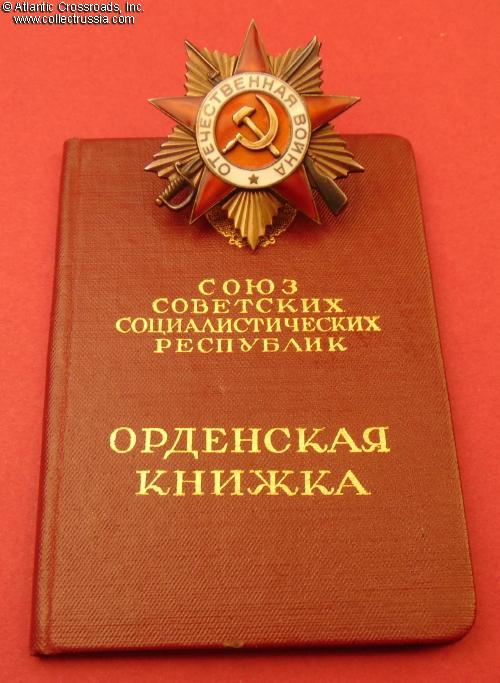
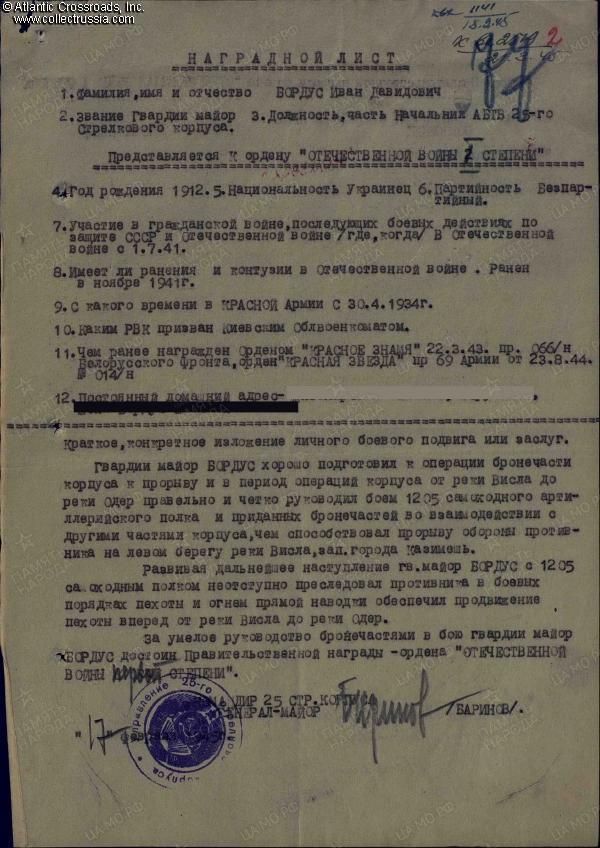
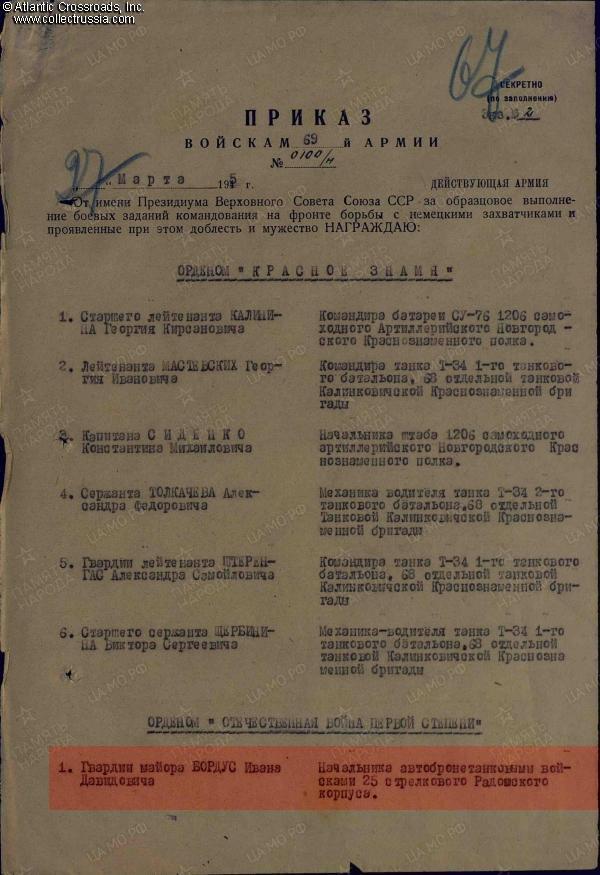
In January 1945, Bordus had the rank of Major and served as commander of the automobile and armored troops of the 25th Rifle Corps, 69th Army. In the Soviet winter offensive from the Vistula to the Oder which spelled doom to the German forces on the Eastern Front, Bordus personally directed the actions of the 1025th Self-propelled Artillery Regiment and additional armor attached to it. In close coordination with the other units of the corps, the 1025th pierced the enemy defense on the left bank of the Vistula near the town of Kazimierz Dolny. Building on its success, the 1025th relentlessly pursued the enemy, clearing a corridor which allowed the infantry to advance all the way to the Oder. For his skillful leadership and command of the armored units in battle, Bordus was recommended for the Order of the Patriotic War 1st cl. which was awarded to him on 27 March 1945.
Bordus remained on active duty for a long time after the war. By the time he retired in February 1959, he had the rank of Lieutenant Colonel, and had received three more decorations for length of service: Medal for Combat Service in 1948, Order of the Red Star in 1950, and Order of the Red Banner in 1951.
Research Materials: b/w photocopy of the award record card and commendations and relevant parts of the award decrees for all three
wartime decorations.
$1,900.00 Add to cart