

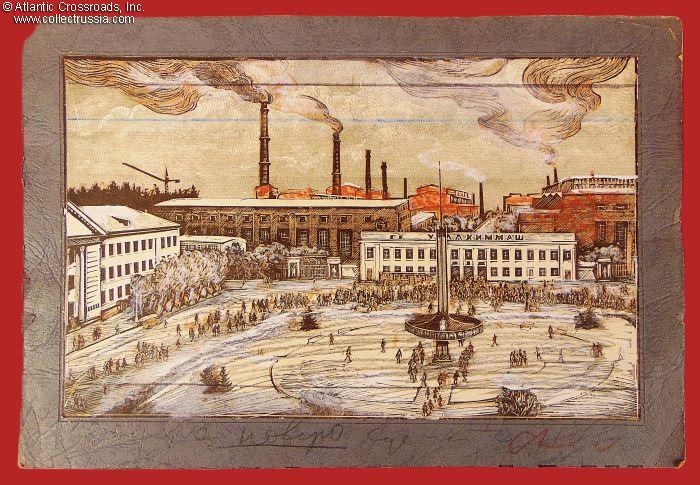
Original Untitled Study for a Lithograph, in Indian Ink and Color Pencils on Drawing Paper, by Valentin Novichenko (Валентин Новиченко), circa 1960s-70s.
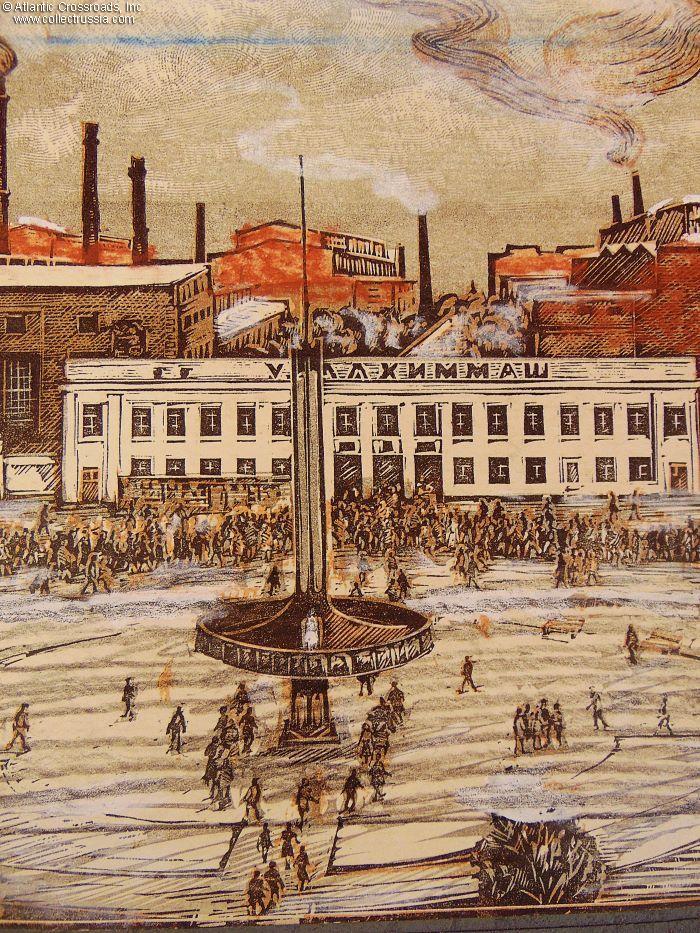
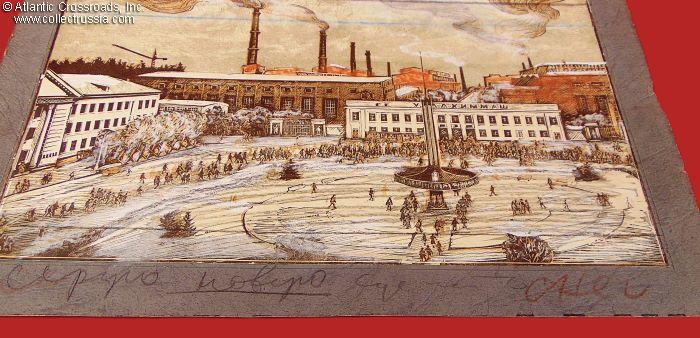
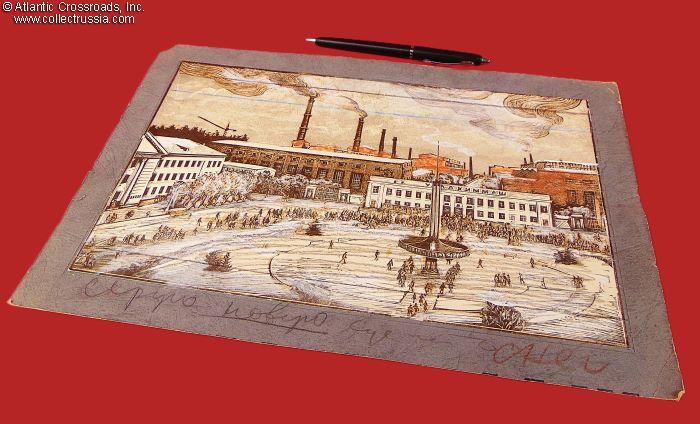
The image measures 11 ¼" x 17", total size with the backing is 13" x 8 ¾". On thick drawing paper affixed to a cardboard backing. The artwork depicts the main entrance to URALKHIMMASH, the Ural Chemical Machine Building Plant in Yekaterinburg in Western Siberia, just east of the Ural Mountains. A river of people flows into the maw of its doors, about to be swallowed by the smoke-belching giant; the time is apparently close to the beginning of a work shift.
Novichenko was among the first to turn upside down the old ideologically worn-out approach of Socialist Realism to the theme
The image measures 11 ¼" x 17", total size with the backing is 13" x 8 ¾". On thick drawing paper affixed to a cardboard backing. The artwork depicts the main entrance to URALKHIMMASH, the Ural Chemical Machine Building Plant in Yekaterinburg in Western Siberia, just east of the Ural Mountains. A river of people flows into the maw of its doors, about to be swallowed by the smoke-belching giant; the time is apparently close to the beginning of a work shift.
Novichenko was among the first to turn upside down the old ideologically worn-out approach of Socialist Realism to the theme of labor heroes where the hero's portrait dominated his tools of labor and the entire environment. Here we see an entirely different dynamic between man and his creation.
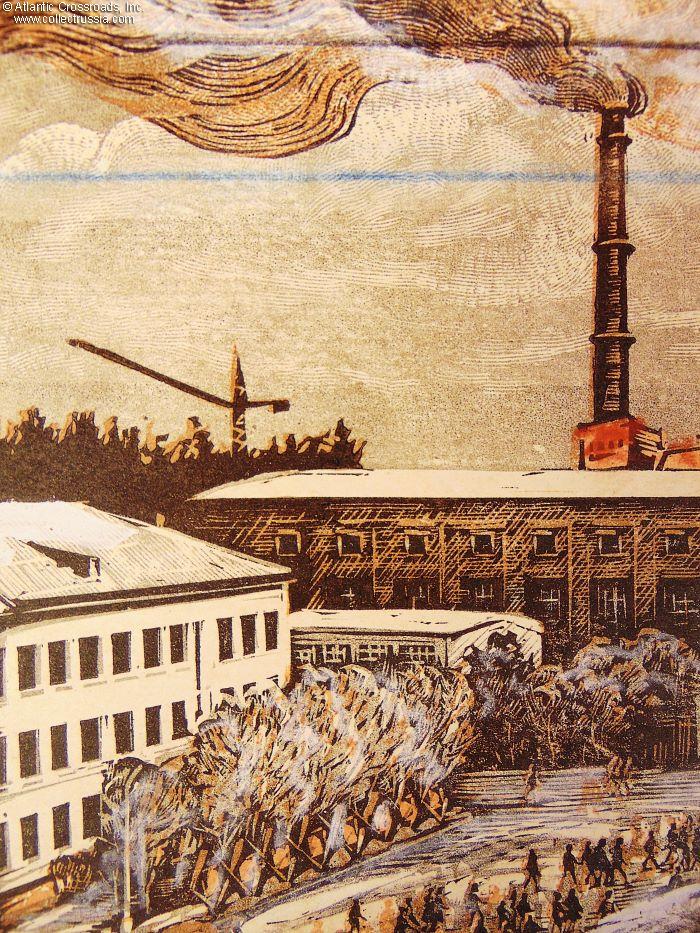
The study is in excellent condition. It is work in progress, hence the three horizontal lines crossing the artwork, and the notation in pencil underneath, something about needing a new gray something, and the word СНЕГ ("snow"). But there are no smears, stains, tears, or any other damage one might expect from a study. The cardboard backing is a little worn along the edges and corners but is quite sturdy and firm.
Valentin Novichenko (Валентин Алексеевич Новиченко, 1927-2010) was a well-known master of graphic arts from the Urals. He was born into a working-class family. His childhood impressions of industry and the construction of the Orsk Metallurgical Kombinat (group of factories) deeply affected his art.
He participated in the Patriotic War and then graduated from the Sverdlovsk School of Arts, which he attended from 1956 to 1961. In 1966 he became a member of the Trade Union of Artists of the USSR and a permanent participant of all-Union exhibitions. From 1953 to 1963 he worked as a decorator at the Uralkhimmash and Uralmash, both of which were gigantic powerhouses of Soviet industry that played an extremely important role in the development of the industrial might of the Soviet Union as well as its defense during the Great Patriotic War. They also played a major role in the development of the city of Yekaterinburg (then Sverdlovsk) and the entire Urals Region.
After the death of the artist in 2010, a number of his exhibitions opened in his native Urals and in Moscow, and well-known collectors are now trying to acquire his works. As is evident from his correspondence with colleagues that is now kept in a private collection, Novichenko had a difficult personality. He never tried to sell his works to collectors or earn favors from the bureaucrats managing arts; he also refused to sell his painting to the managing committees of exhibitions on their terms. He was a tireless innovator, always in search of new materials and techniques, and this consumed his entire life. His lithographs on metal or so-called "poly-etching graphics" that employed various techniques and metal cutting instruments invented by him, make his art truly unique and of enduring value.
Please note that the pen in our last photo is for size reference.
$130.00 Add to cart