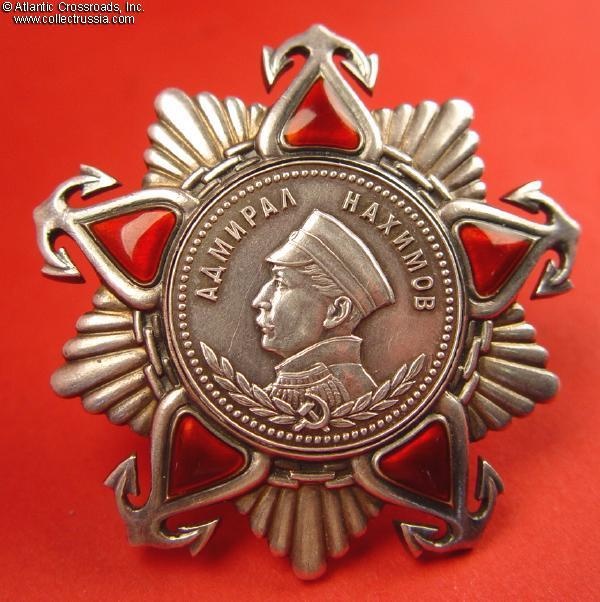
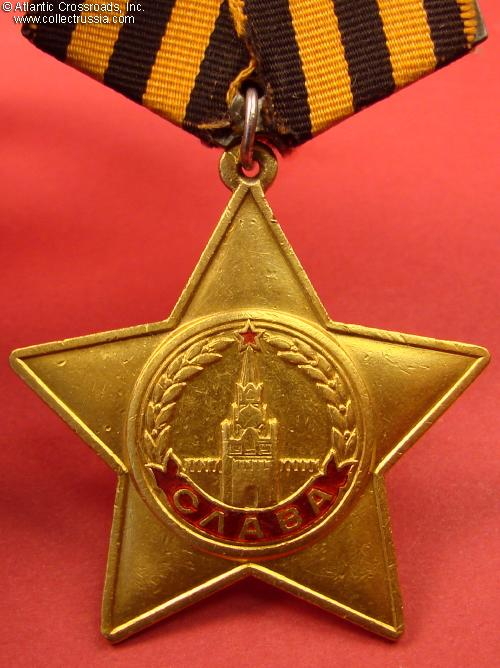

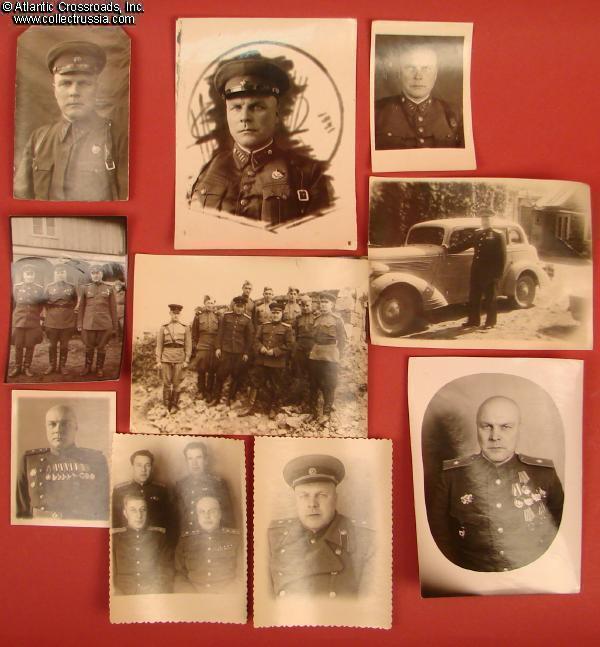
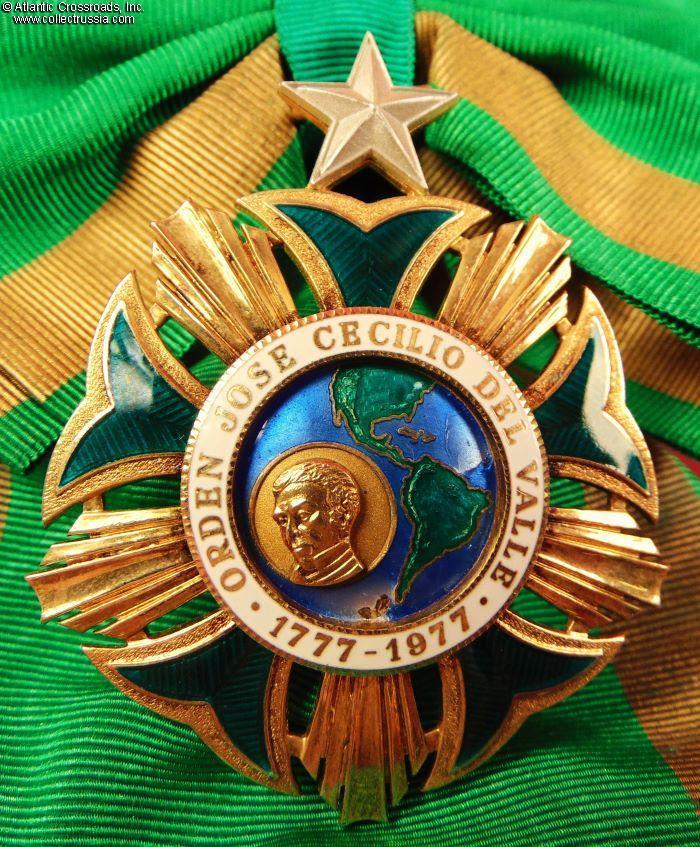

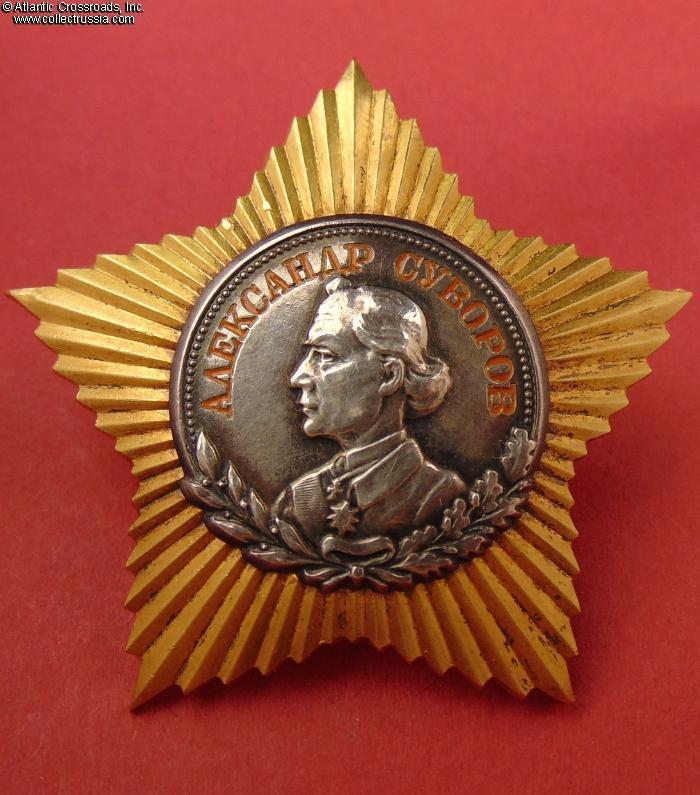
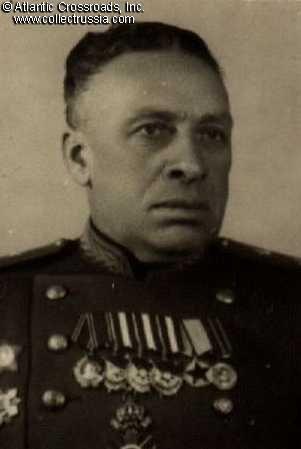
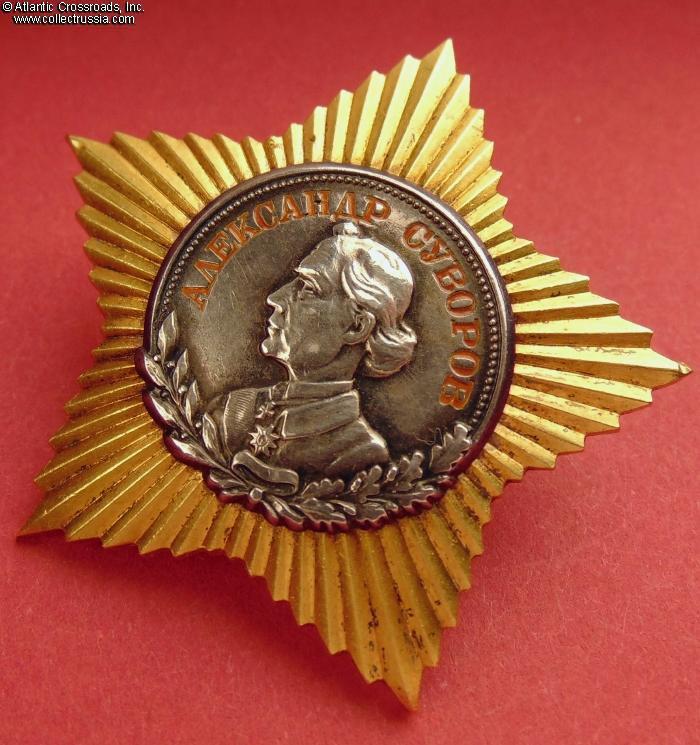
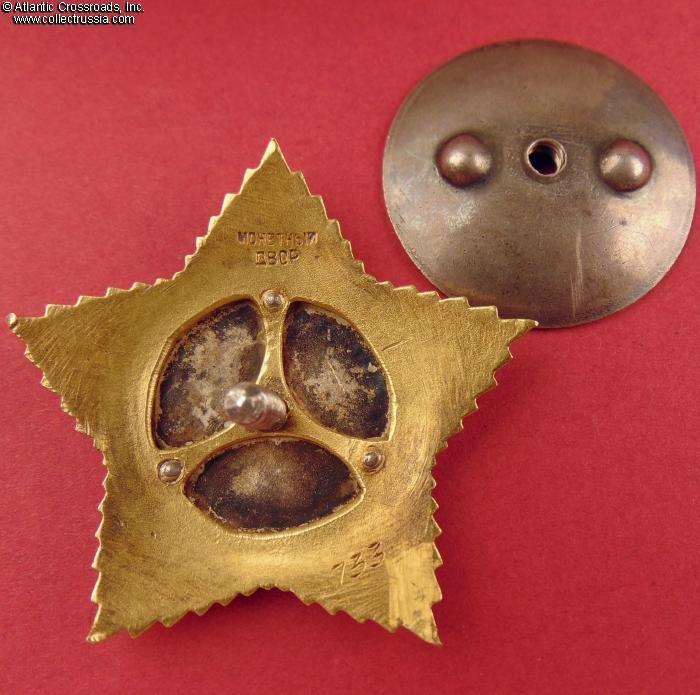
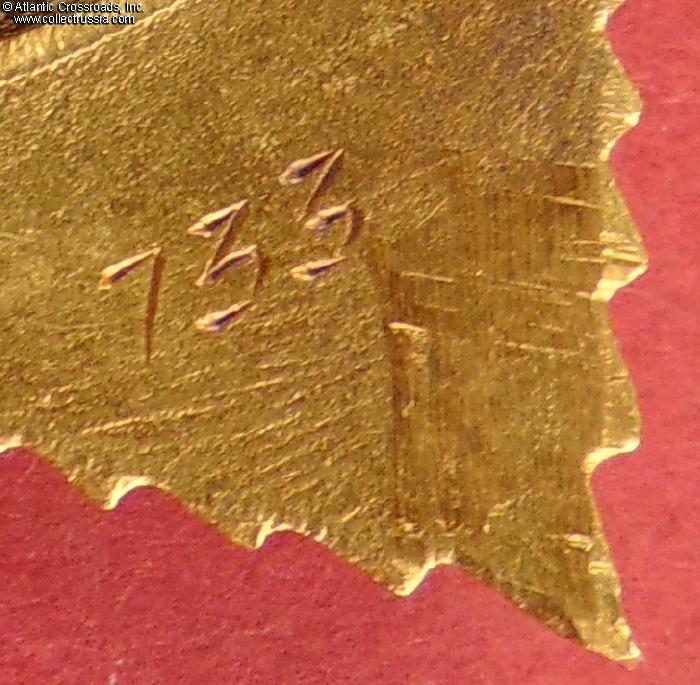
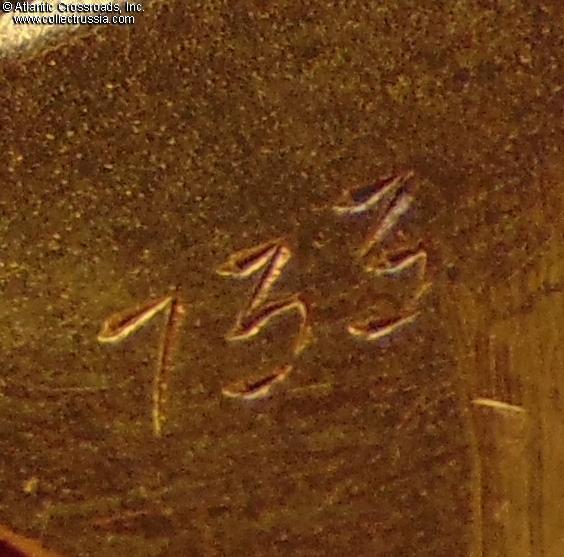
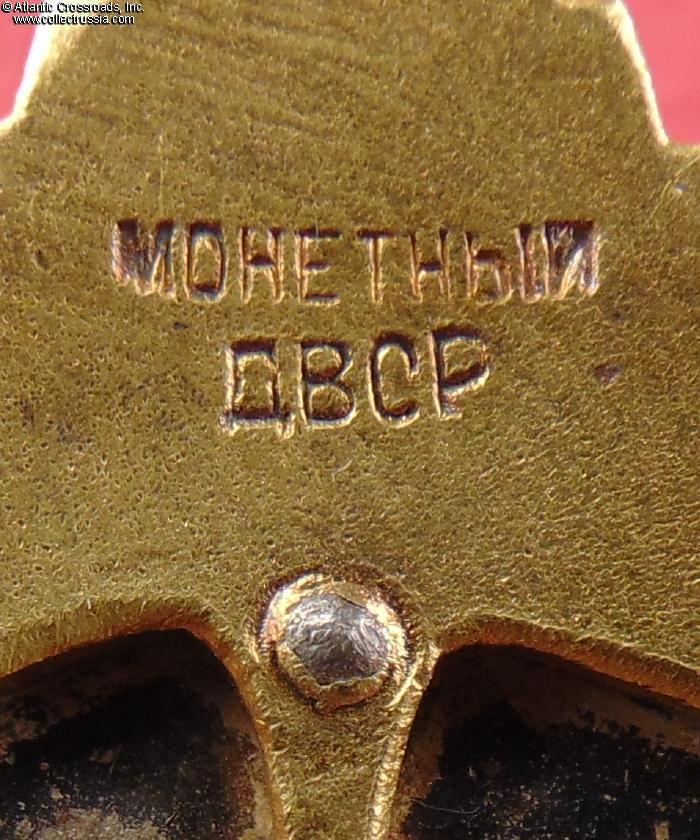
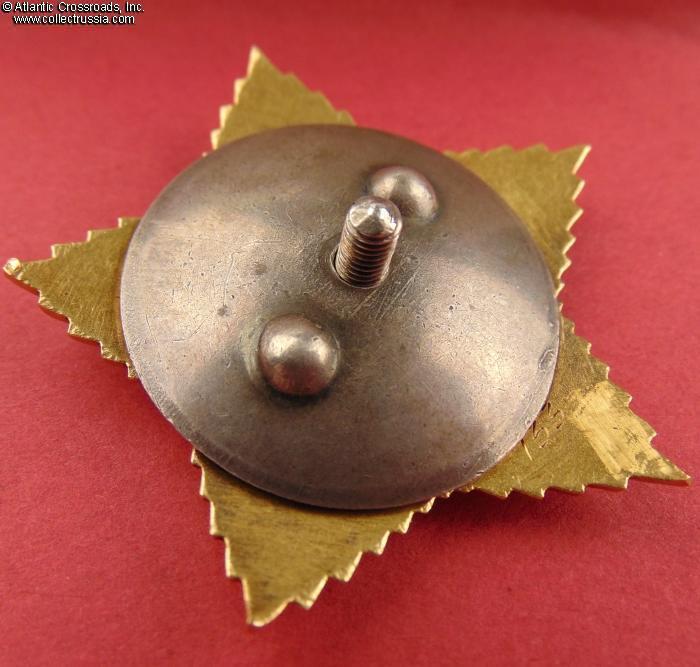
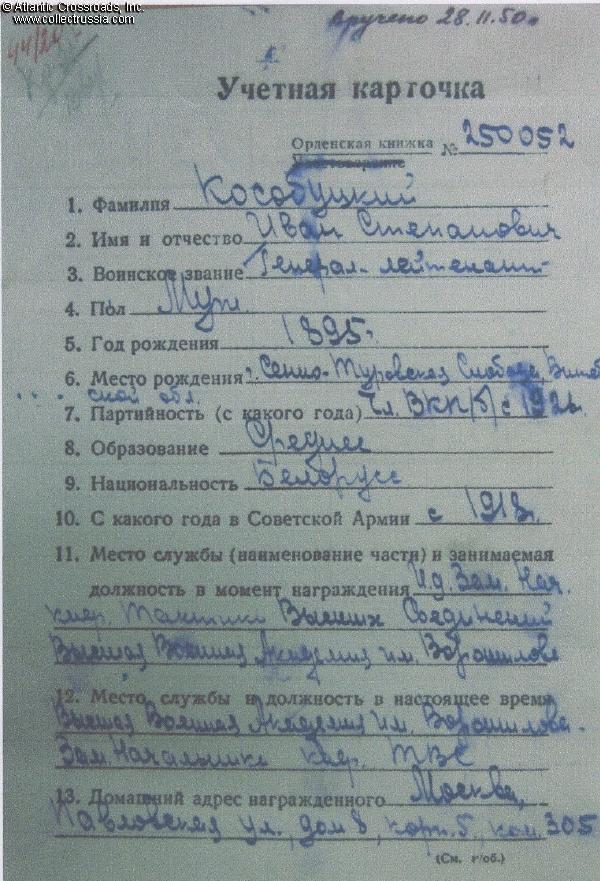
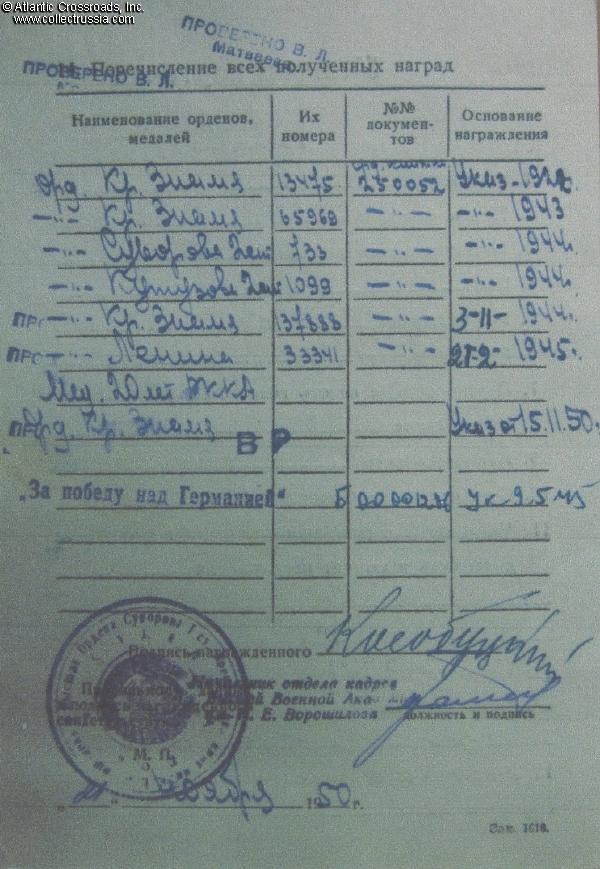
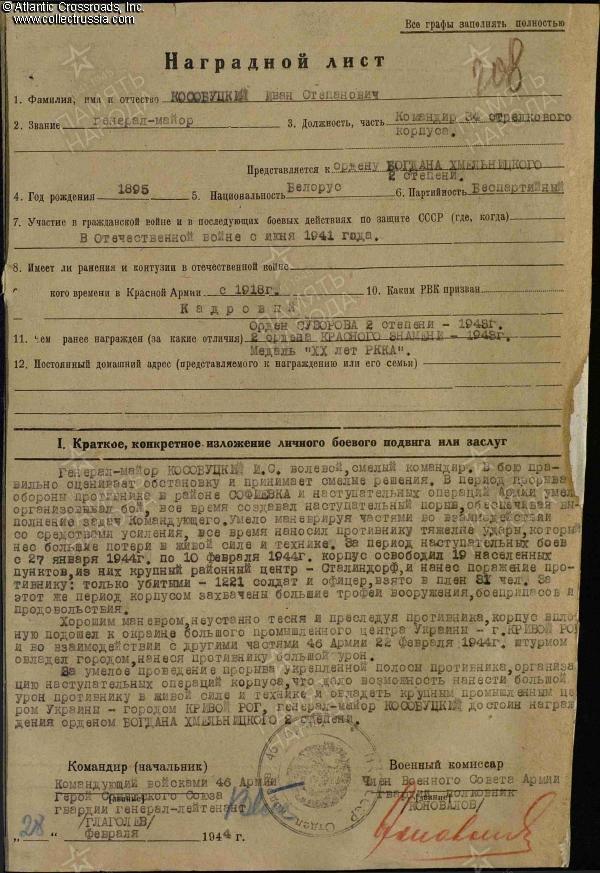
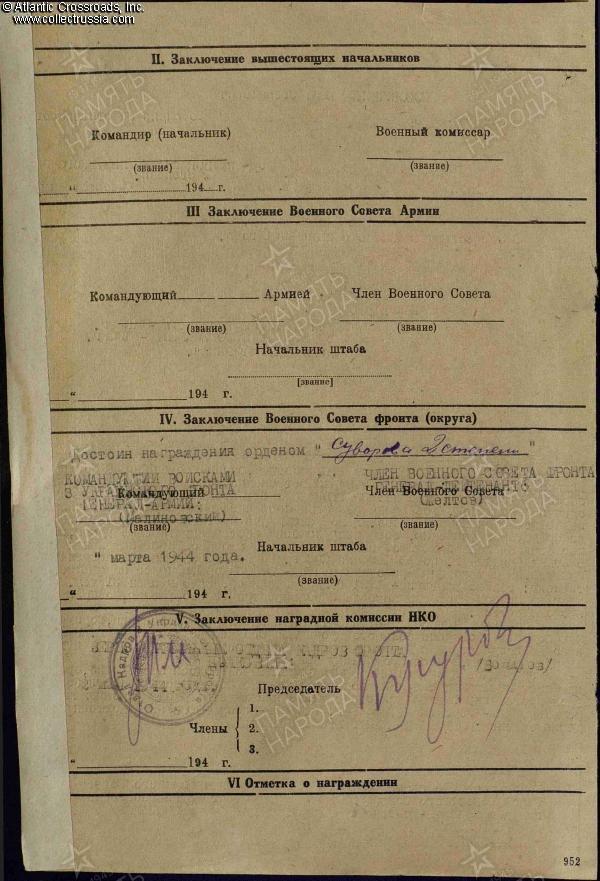
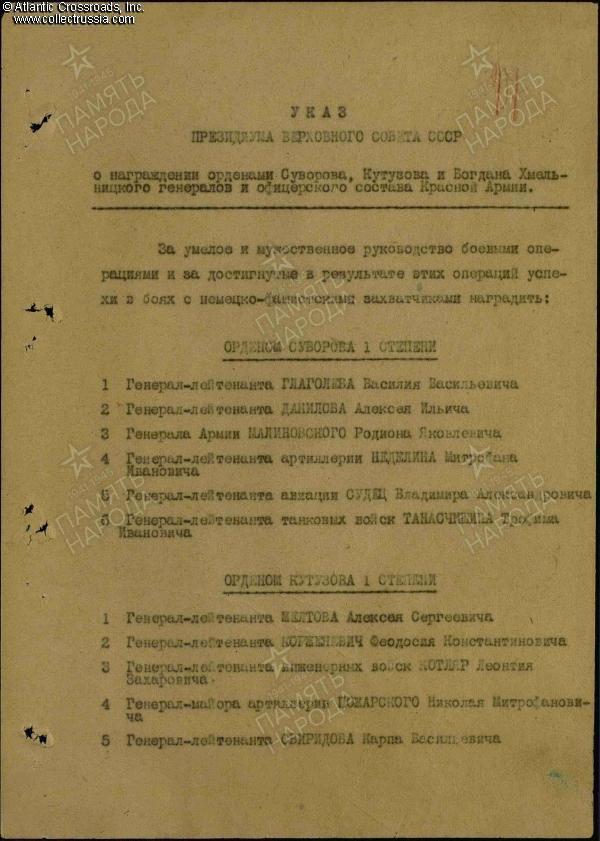
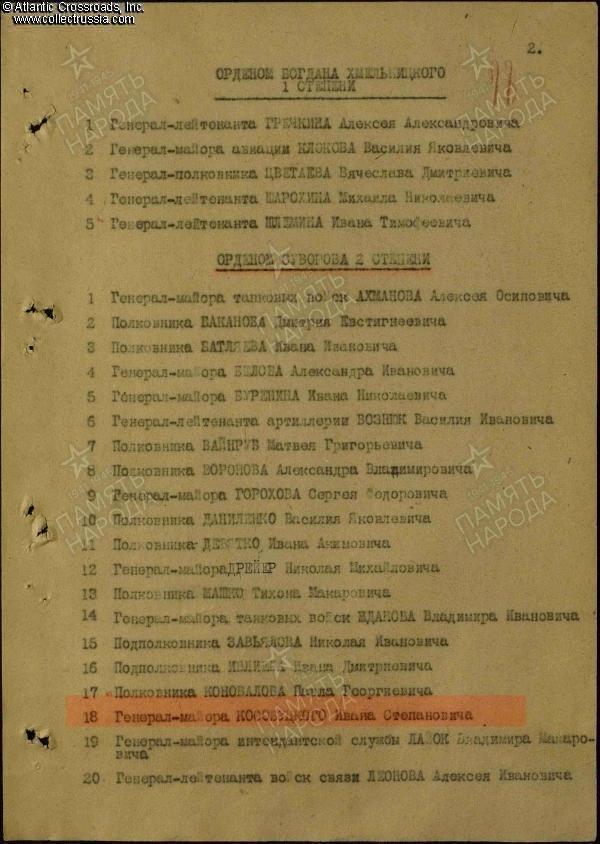
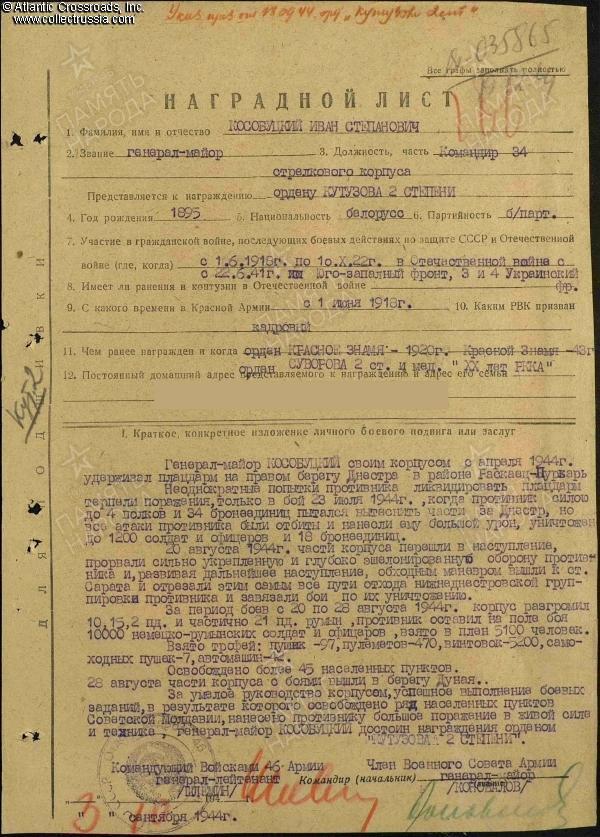
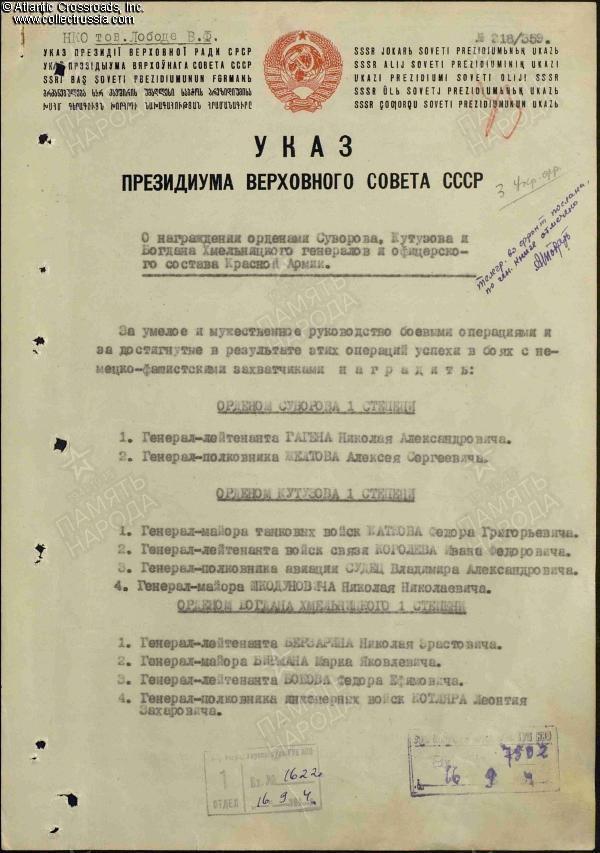
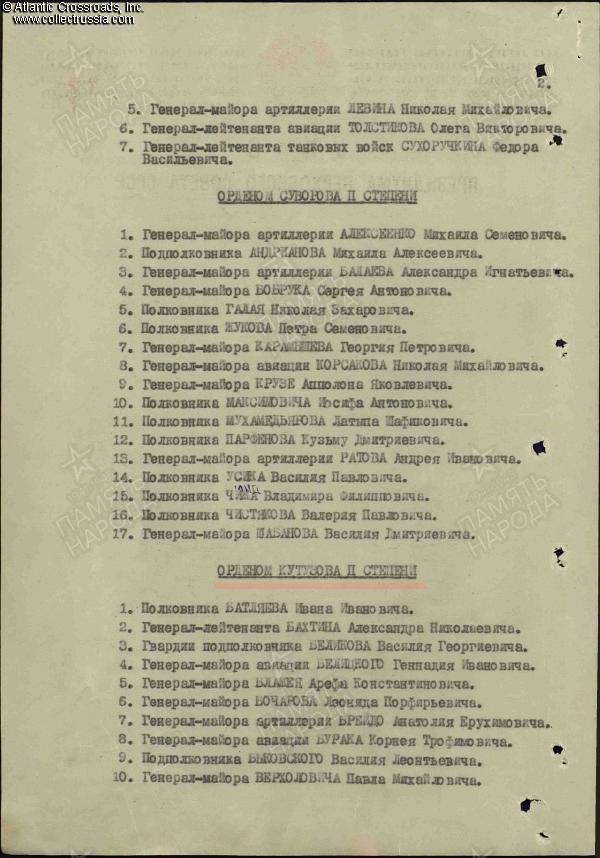
Order of Suvorov, 2nd class, Type 2, #733, awarded on 19 March 1944 to Major General Ivan Kosobutskiy (Иван Степанович Кособуцкий), Commander of the 34th Rifle Corps, 46th Army, 3rd Ukrainian Front.
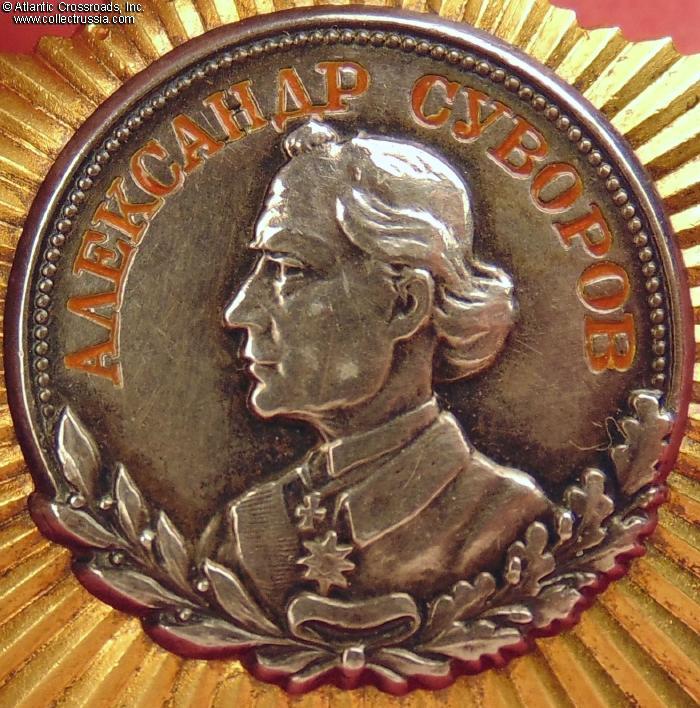
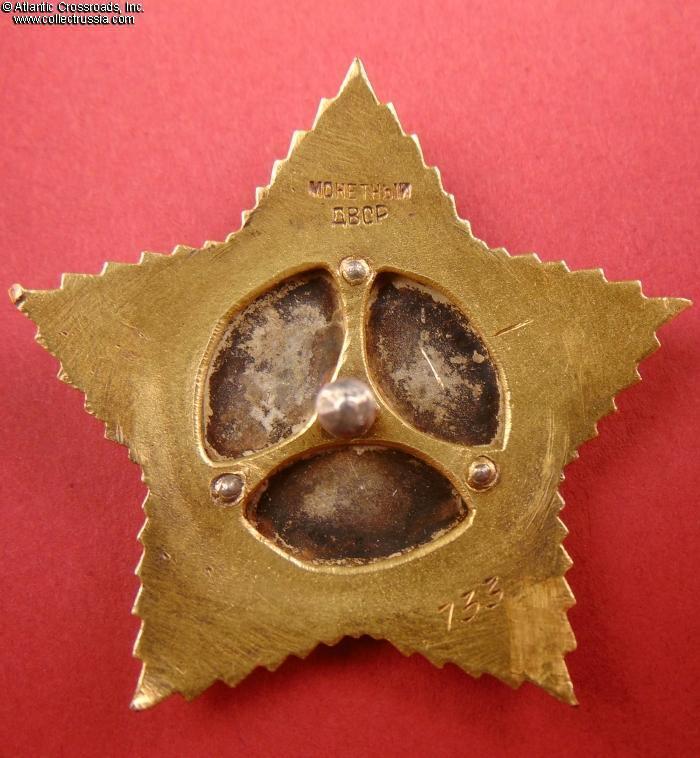
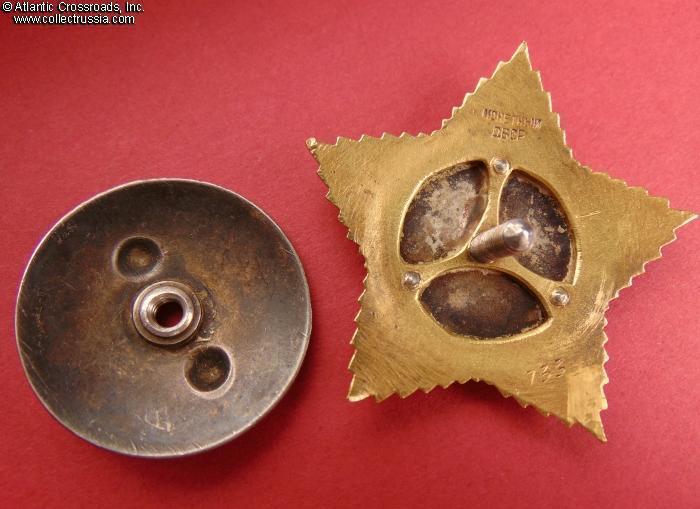
Gold, silver (center medallion), enamel. Measures 47.3 mm in height, 50.1 mm in width; weighs 30.2 g without the screw plate. Note the very low serial number, at the lower end of serial number range observed for the screw back type. Characteristically crisp high-quality early strike, better than most specimens of later vintage. A beautiful example!
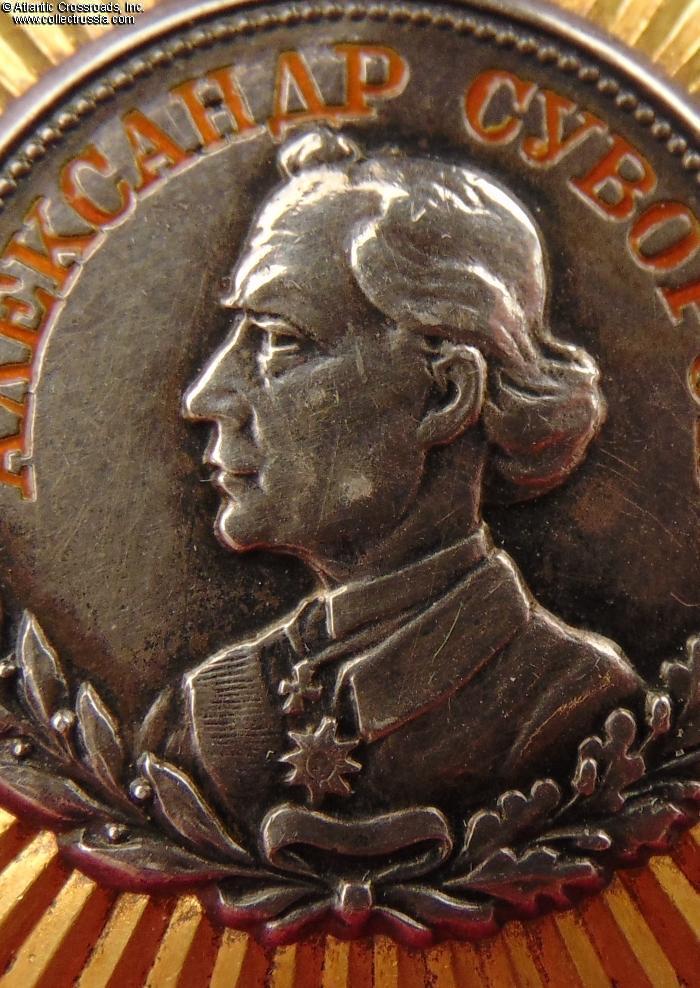
Very fine to excellent overall condition. The center medallion is exceptionally well-preserved and shows practically no wear. The bas-relief portrait is perfect and its raised details are exceptionally crisp. The enamel in the let
Gold, silver (center medallion), enamel. Measures 47.3 mm in height, 50.1 mm in width; weighs 30.2 g without the screw plate. Note the very low serial number, at the lower end of serial number range observed for the screw back type. Characteristically crisp high-quality early strike, better than most specimens of later vintage. A beautiful example!
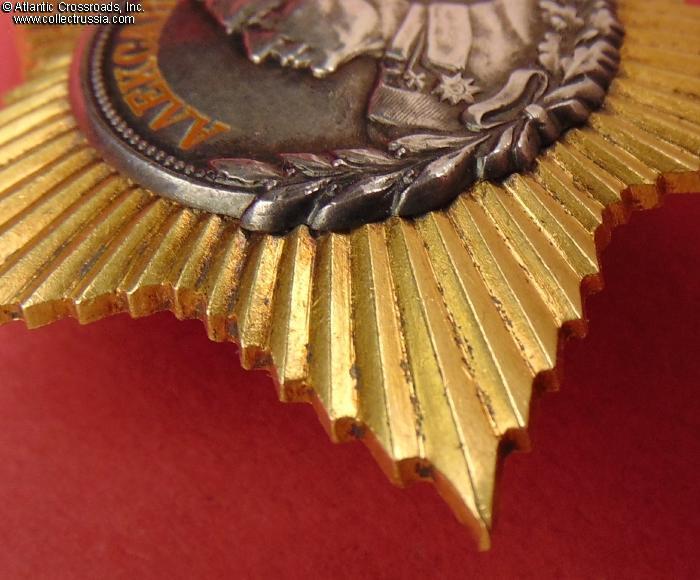
Very fine to excellent overall condition. The center medallion is exceptionally well-preserved and shows practically no wear. The bas-relief portrait is perfect and its raised details are exceptionally crisp. The enamel in the letters is likewise perfect. The gold rays of the starburst have two small nicks at the tips of the upper right and upper left arms; there are also mild bumps to the tips of the same arms visible from the reverse. Additionally, the starburst has some tiny, almost unnoticeable dings, but its ridges remain nice and crisp.
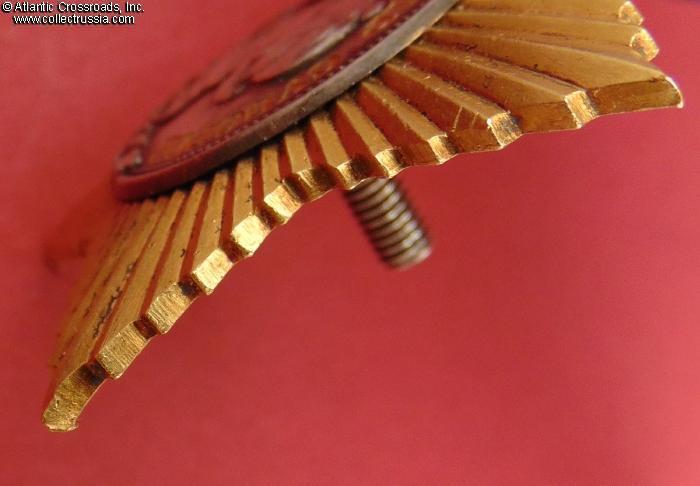
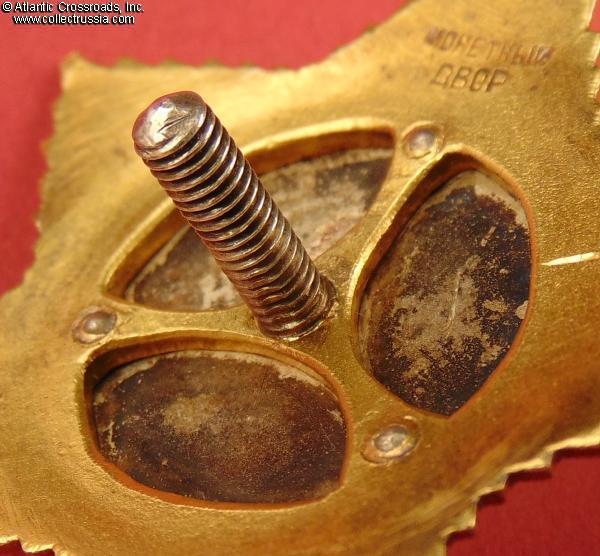
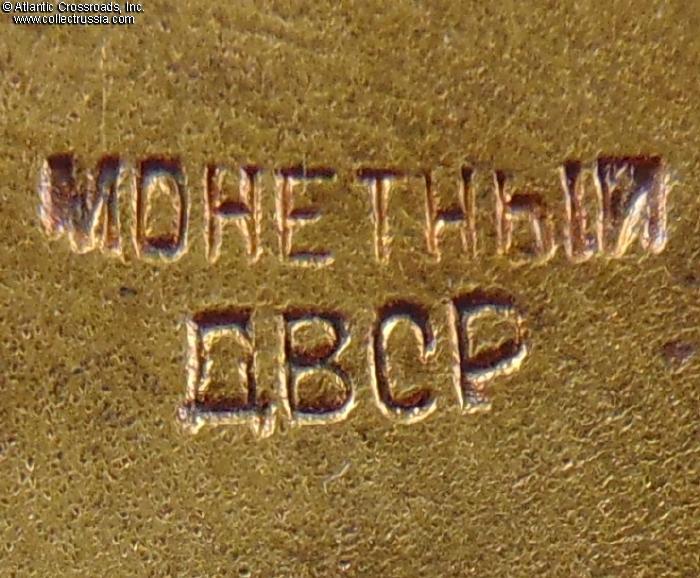
On the reverse, there is a scuffed area at approximately 5 o'clock position near the tip, apparently a result of amateur testing for gold content, which does not affect the serial number. There is also a single thin scratch at approximately 2 o'clock. The rest of the reverse remains practically untouched, exhibiting a very attractive toning to the gold and dark patina to the silver of the center medallion. The characteristic wrinkles on the reverse of the rays and mint mark are pristine. The screw post is of full length, over 13.5 mm long measured from the golden "spokes" of the starburst, and includes an original period screw plate in silver.
To summarize, this is a very well-preserved and extremely attractive early piece. Its few minor flaws do not affect its overall appearance in the least.
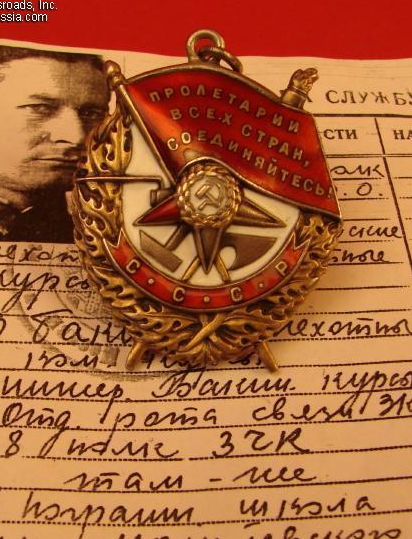
Ivan Kosobutskiy was born in 1895 in the town of Senno in the Vitebsk region of Belorussia (then a part of the Russian Empire). In 1915, he graduated from the 7th Moscow School of Warrant Officers and through 1917 fought in the First World War on the Western Front as an assistant company commander. In June 1918, at an early stage of the Russian Civil War, Kosobutskiy was drafted into the Red Army and appointed deputy commander of the Senno People's Infantry Regiment. Starting from October 1918 he fought on the Western Front, soon rising to a regiment commander. He took part in actions against Semion Petliura's Ukrainian pro-independence army, fought and was wounded in action in the Soviet-Polish War in 1920, and confronted the forces of Gen. Bulak-Balakhovich in Belorussia in 1921. During the Civil War, Kosobutskiy earned his first decoration, the Order of the Red Banner of RSFSR (#13475), that was bestowed upon him in 1922.
After the conclusion of the Civil War Kosobutskiy remained on active duty in the military and upon graduating from the prestigious Frunze Military Academy in 1930, was appointed Chief of Staff of the 9th Rifle Corps, North Caucasus Military District. For much of the 1930s, he continued to serve as chief of staff of various divisions and corps until his appointment to the Kiev Military District as a corps commander and later, senior inspector and chief of staff of the district (his quick promotion may be due to the fact that the original Kiev District command had been virtually wiped out during the Stalin's purge of the military.) Interestingly, from January - August 1940, Kosobutskiy was on what was euphemistically called a "business trip" (i.e. special assignment, likely to a foreign country) of the Deputy Narkom (People's Commissar) of Defense Shchadenko.
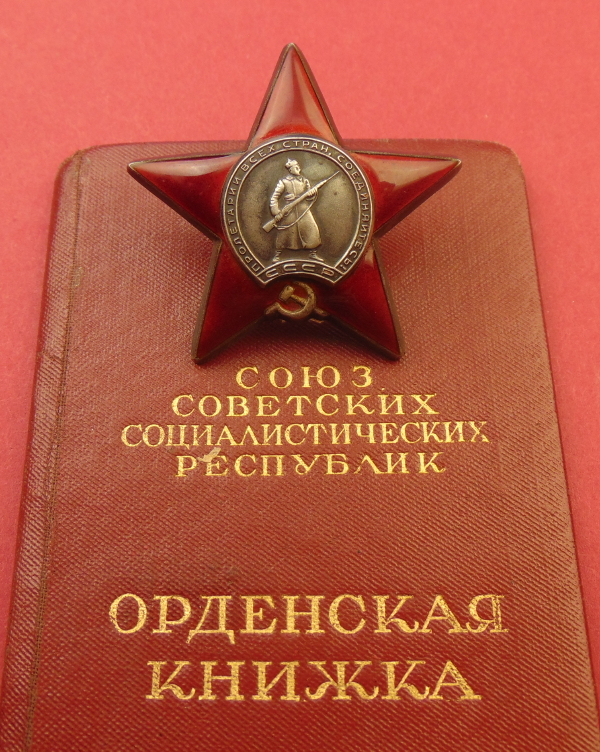
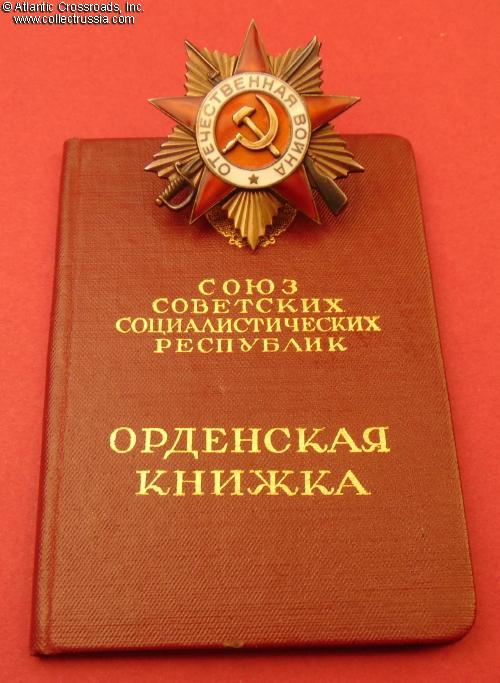
Kosobutskiy met the beginning of the Patriotic War as commander of the 41st Rifle Corps, Northwestern Front, which in early July 1941 fought heavy defensive battles, ensuring the withdrawal of the troops of the front from the line of the Western Dvina River to the Pskov-Ostrovskiy Fortified District. Like many other high-ranking Red Army officers, Kosobutskiy was blamed for the early Soviet disasters, stripped of his rank, court-martialed, and sentenced to 10 years in the GULAG. In late October 1942 however, he was released from prison and sent to the front (probably not coincidentally, the defensive phase of the Battle of Stalingrad had just reached its critical point, and there was a severe need of experienced military cadres.) A year later, Kosobutskiy's conviction was completely expunged by a special decree of the Supreme Soviet, and he was reinstated in the rank of Major General - although his Party membership was not restored at that time.
From December 1942 Kosobutskiy was assistant commander of the Northwestern Front for the formation of reserves. In this capacity, he earned his first decoration of the Patriotic War, the Order of the Red Banner (#65969). It was awarded on 26 October 1943 for Kosoboutskiy's excellent performance and in particular, facilitation of the Front's advance in the area of Zmiev.
After being seriously wounded and convalescent in a hospital, Kosobutskiy was appointed Commander of the 34th Rifle Corps, which at various times would be a part of the 1st Guards, 46th, 57th and 37th Armies of the Southwestern and 3rd Ukrainian Front. With this unit, Maj. Gen. Kosobutskiy took part in the battle for the Dnieper River line, in the Nikopol-Krivoi Rog, Odessa, and Iasi-Kishinev offensives, and the liberation of the cities of Dnepropetrovsk, Krivoi Rog, Shumen (in Bulgaria), and Constanta (Romania).
During the Red Army offensives in Ukraine in the early months of 1944, Kosobutskiy showed outstanding leadership and skills. On 22 February, his corps alongside other units of the 46th Army stormed and seized the city of Krivoi Rog (Kryvyi Rih), a highly important industrial and mineral mining center of Ukraine. From 27 January - 10 February, 34th Rifle Corps liberated 19 settlements in the Dnepropetrovsk region, including the town of Stalindorf (now Vakulovo), a pre-war center of the Jewish National District which had been largely depopulated during the Nazi occupation. During this period, the corps eliminated 1221 enemy soldiers and captured 81 POWs. It also captured massive amounts of weapons, ammunition and food stores.
For his outstanding leadership in the offensive operations in Ukraine and in particular, his role in the liberation of Krivoi Rog, Kosobutskiy was recommended for the Order of Bogdan Khmelnitsky 2nd cl. by the 46th Army Commander Guards Lt. Gen. Glagolev (one may find the choice of award ironic, given that it was in part for the liberation of the Jewish national center and that the real-life Khmelnitsky was one of the most infamous persecutors of Jews in history). The recommendation was then upgraded to the Order of Suvorov, 2nd cl. by the Commander of the 3rd Ukrainian Front General of the Army Malinovsky. On 19 March 1944, the award was officially bestowed upon Kosobutskiy by a decree of the Presidium of the Supreme Soviet of the USSR.
Starting from April 1944, Kosobutskiy's corps was tasked with holding a bridgehead on the right bank of the Dniester River around villages of Răscăieți and Purkari, Moldova. The corps repelled numerous German and Romanian attempts to liquidate the bridgehead, holding firm and inflicting heavy losses on the enemy. In just one such defensive battle on 23 July 1944, the corps eliminated up to 1200 enemy soldiers and 18 armored vehicles.
On 20 August, the corps went over to the offensive, broke through a heavily fortified defensive line, and using a flanking maneuver reached the railway station of Sarata, thus trapping the lower Dniester group of enemy troops. From 20-28 August, the corps destroyed three Romanian infantry divisions and parts of the fourth, killing some 10,000 enemy soldiers and capturing 5,200 prisoners. It also liberated 45 settlements and by 28 August, reached the Danube. For this brilliant success, on 13 September 1944 Kosobutskiy was awarded with the Order of Kutuzov, 2nd cl. (#1099) . On the same day, he was promoted to Lieutenant General.
Starting from October 1944, the 34th Rifle Corps was a part of the Soviet army of occupation in Bulgaria and therefore took no further part in the fighting. After the end of the war, Kosobutskiy briefly served as Chief of Staff of Combat and Physical Training of the Southern Group of Soviet Forces, before receiving a position of an instructor at the Voroshilov General Staff Academy, the highest of all Soviet military education establishments. In 1949, he rose to a department chief in the academy and in 1953 was transferred to the reserves. He passed away in Moscow in 1974.
Research Materials: photocopy of the award record card and award commendations for the Order of Suvorov, 2nd cl., Order of Kutuzov, 2nd
cl.; and the 1943 Order of the Red Banner; English-language biography of Lt. Gen. Kosobutskiy. Ample information about him is also available
in various published and Internet sources, such as Commanders of the Corps, Biographical Encyclopedia (by Basik, Vvedenskiy et al. C.
2006, Moscow) and Russian- and English-language Wikipedia articles.
$18,000.00 Add to cart