








































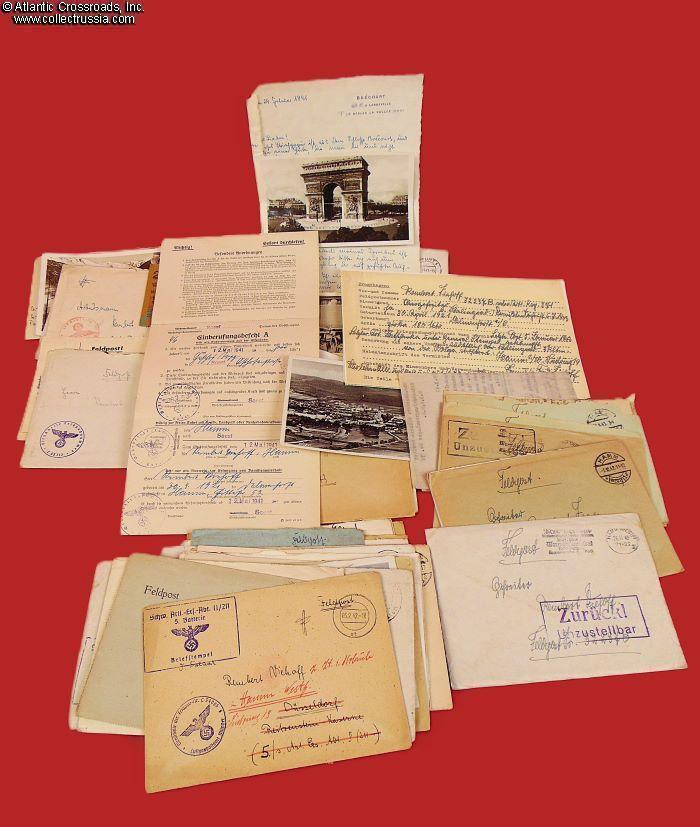
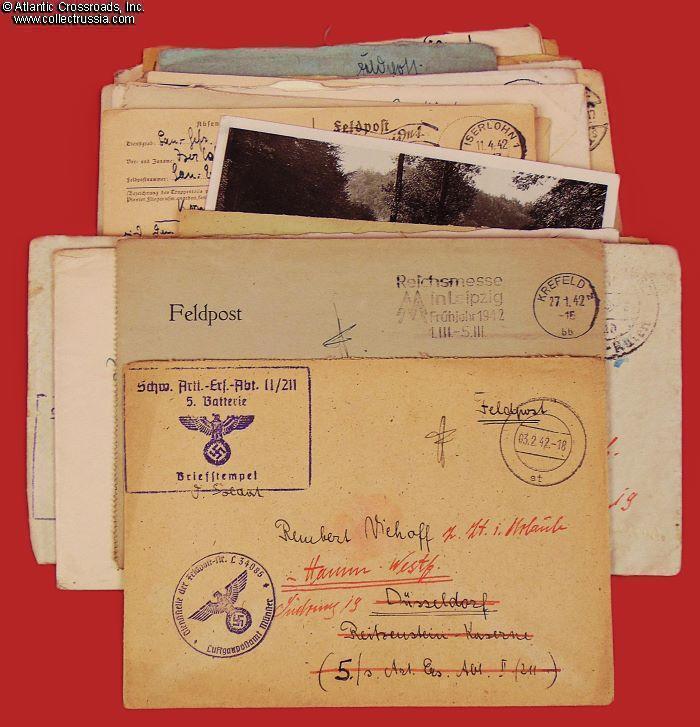
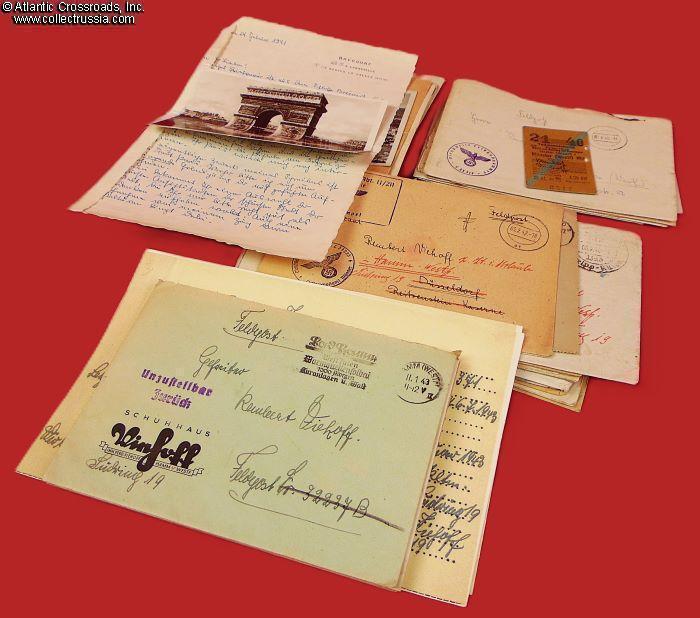
Collection of 77 Letters and Postcards to and from Rembert Viehoff, a WW2 Wehrmacht Artillery NCO Who Went MIA at Stalingrad, 1940-43.
This very large collection provides a rare opportunity to trace the life and fate of an ordinary German youth, a rank-and-file Wehrmacht soldier who perished in the meatgrinder of the Battle of Stalingrad. The letters have been sorted chronologically; some of them we have translated as thoroughly as we could (the handwritings leave much to be desired, to say the least), mostly excerpts we found interesting but some of the short ones in their entirety. Looking at the horror of that war from the distance of today, it largely remains a mystery for us how it could have been perpetrated by p
This very large collection provides a rare opportunity to trace the life and fate of an ordinary German youth, a rank-and-file Wehrmacht soldier who perished in the meatgrinder of the Battle of Stalingrad. The letters have been sorted chronologically; some of them we have translated as thoroughly as we could (the handwritings leave much to be desired, to say the least), mostly excerpts we found interesting but some of the short ones in their entirety. Looking at the horror of that war from the distance of today, it largely remains a mystery for us how it could have been perpetrated by people like this.
1940
Hamm, North Rhine-Westfalia, a city in the northeastern part of the Ruhr area. Letter from Gefreiter (corporal) Hermann, FP #20514 E, then assigned to Staff of the 4th Company, 503rd Infantry Regiment. Dated 19 March 1940.
"My Dear Rembert!
Thank you so much for your package and your message. I wish you and your parents a happy and blessed Easter. Unfortunately, I didn't get any vacation time. What a shame! There is no church here, and it is unlikely that an open-air church service will be held for the holiday. Your Stations of the Cross for the Holy Week is a welcome substitute for me. I like it very much. I will especially miss the liturgy of the Holy Week. It doesn't look like spring here at all. Storms and blizzards alternate. Spring is making its presence felt not only in nature, but also in politics. Showers are coming. With warmest regards, Your H."
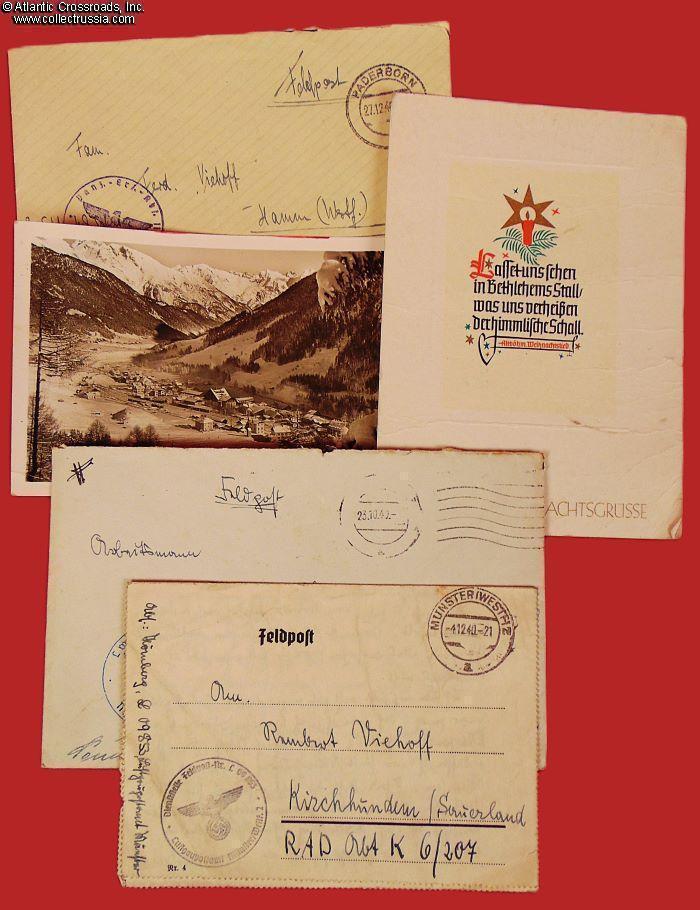
Until 7 June 1940, letters are addressed to the city of Hamm, 52 Hitlerstrasse, the Viehoff family home address. In September, Viehoff apparently was conscripted into the Reichsarbeitsdienst, or R.A.D., the organization established in Nazi Germany to provide labor for public projects, militarize the workforce, and indoctrinate youth with Nazi ideology. R.A.D. performed construction projects, provided combat support, and supplied labor for the Wehrmacht. The Christmas postcard dated 22 December 1940 had the previous R.A.D. address crossed out and replaced with "Feldpost 19173," the number assigned to R.A.D. Department 6/207.
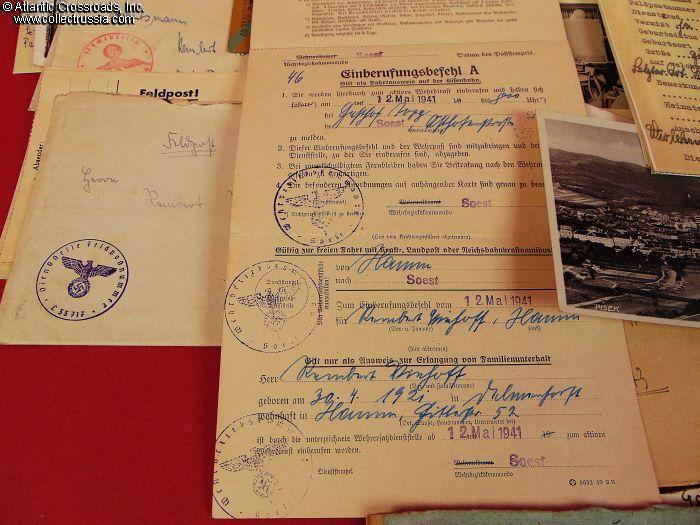
A photo postcard with a view of the Czech city of Pisek, South Bohemian Region, came to Viehoff's Feldpost #19173 from Helmut Schmitz, apparently a buddy from R.A.D. who was now a Wehrmacht private stationed in Pisek. He shares his joy over finding his "neue Heimat" (new homeland) there.
1941
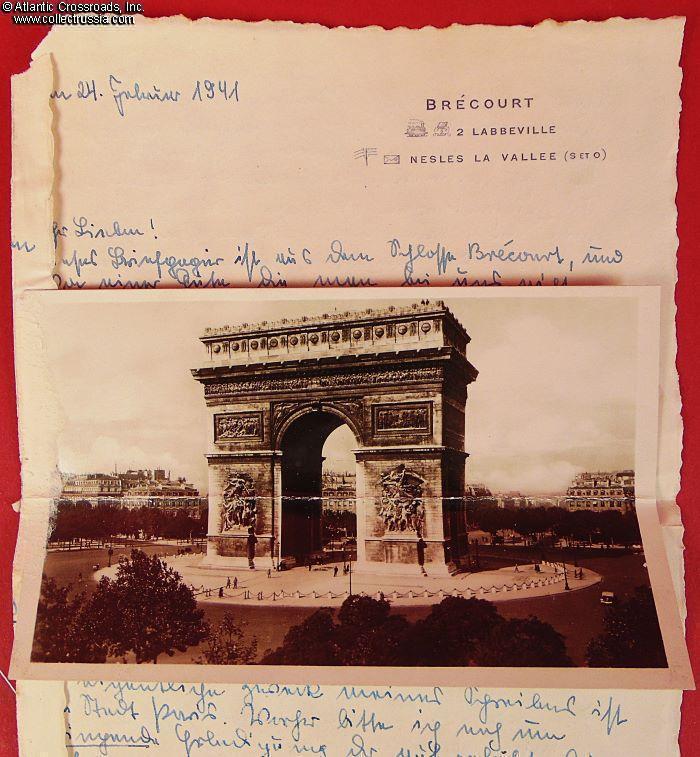
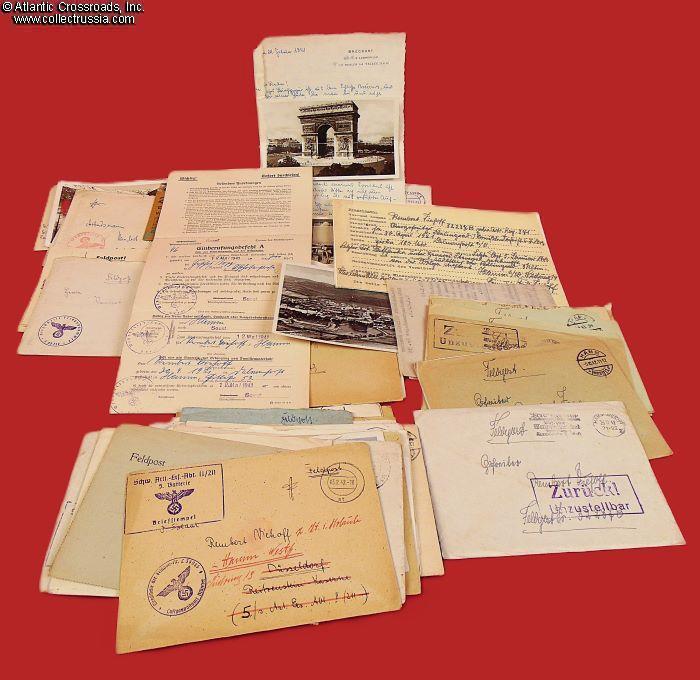
In late February 1941, Rembert writes a letter to his parents from Paris, France, and even encloses a photo with Arc de Triomphe. Too bad his chicken scratch is absolutely unreadable, at least not to a non-native German speaker but, generally, German occupiers had a fun time in Paris. In any case, the photo tells the story of the German occupation of France rather eloquently. Note just one car and, perhaps, no more than a dozen people in the entire huge square around the Arc, in the middle of the day.
The letter dated 25 February 1941 is from someone, probably a friend, serving in a Panzer Brigade stationed in Paderborn, a city in western Germany. He wrote "Last Sunday I met with Helmuth Wigge. He is actually a tanker now with R.O.A." (Reserveoffizieranwarter, reserve officer candidate).
Some of the following letters, dated March 1941, are addressed to "Obervormann Viehoff". Apparently, Rembert was rising in the ranks of R.A.D. and had become a senior foreman.
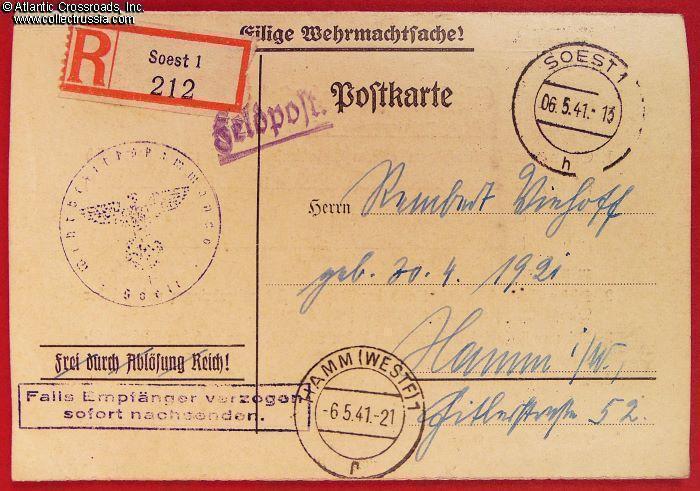
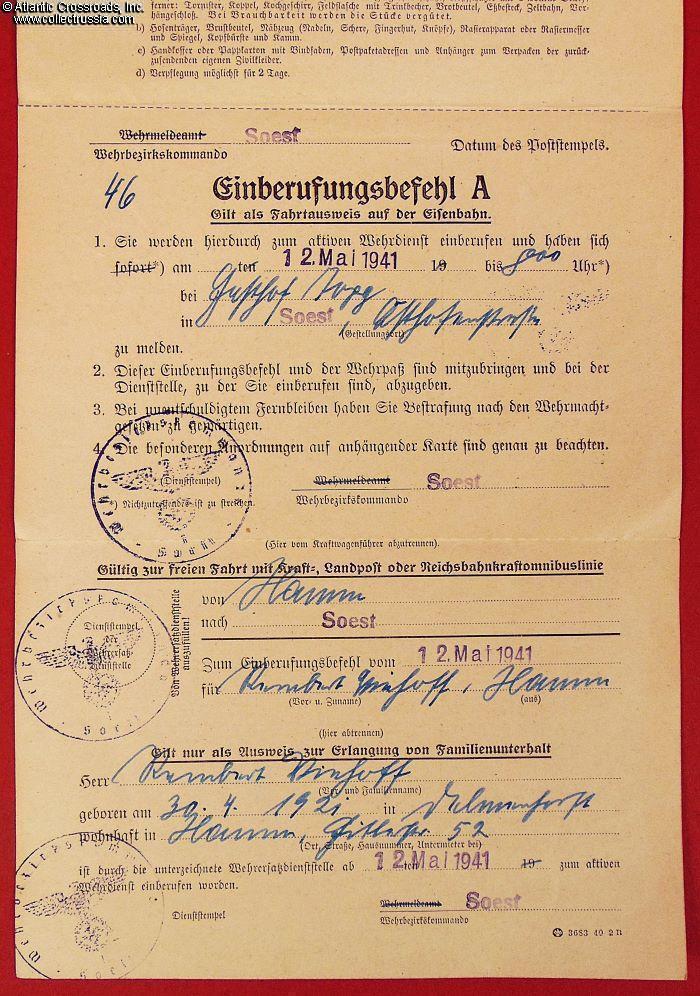
On 6 May 1941, Rembert Viehoff was issued his conscription order, sent by registered mail from the District Military Command in Soest, a city about 15 miles southeast of Hamm. The order stated that Herr Viehoff was hereby called up for active military service and must report to Soest by 8 a.m. on May 12, 1941. The order was mailed to Viehoff's home address, 52 Hitlerstrasse, Hamm, so, evidently, he served in R.A.D. while living at home.
The photo postcard with the view of the Reichstag from the Spree River is already addressed to Private Viehoff of an artillery brigade stationed in the Reitzenstein Barracks in Dusseldorf. A sentimental postcard was sent to Rembert on 20 June by a Rosemarie (girlfriend? sister?) saying "Dear Rembert! I'd like to send you very warm Sunday greetings and many good wishes. A letter will follow. No empty promises, but deadly serious. Rosemarie."
In August 1941, Rembert receives a letter from someone whose furlough was over and he had to return to active duty in FP #09853, at the time assigned to Department 747 of the 2nd Reserve Light Antiaircraft Battery located in Munster. It has an interesting ending! "I will inform you, by the way, that Paderborn has a new archbishop. [????] Now he is 49 years old. In 1939 he volunteered for military service and has been with the troops ever since. I'm quite happy about this choice! A small ray of hope! When one looks at church life in general, one feels a pang of sadness in one's heart. The Gestapo is raging more fiercely than ever before. Cloisters are being closed; in the years since, a mass die-off has begun. As a result of all this, the mood at home has suffered greatly. The radical elements are gaining ground. For a religious person, the limit of what is bearable has been exceeded. It is made difficult to fight for our Reich. We take stock of our lives - and we like doing so! As a thank you though, we will get a kick."
Letters continue to come to Rembert's address at the Dusseldorf barracks from a few different men, probably friends from the past, until the end of 1941. Two postcards sent by Rembert are in the 1941 stack. Unfortunately, his handwriting had not gotten any better.
1942
In January 1942, Rembert got a furlough at least a month long since the letter to him postmarked 9 February is still notated "at the time on furlough in Hamm, Westfalia." The next letter in our possession, dated 4 March, was addressed to the Dusseldorf Barracks and was not readdressed to Hamm.
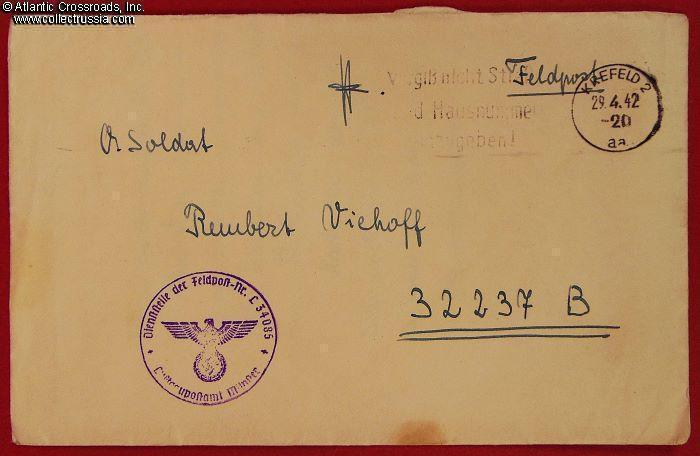
Sometime before 20 April, Rembert's Feldpost number had changed to 32237 B, and Rosemarie was the first to send him a short card wishing him "all the best and lots of love on your special day." (Rember was born on 30 April 1921, and was just about to turn 21 years old.) The letter was addressed to "Obersoldat" Viehoff, Wehrmacht rank of "senior private." Field Post #32237 B was then assigned to Staff IV Department, 9th Battery, 371st Artillery Regiment, 371st Infantry Division, 15th Army. Looking forward, this Field Post number was "canceled" on 12 March 1943, after the Battle of Stalingrad. Not all of Rembert's friends were aware of his new address. His tanker friend from Pisek, Czechia, still wrote to the Dusseldorf Barracks.
By 16 June 1942, Rembert had been promoted to the rank of Gefreiter (corporal). In his 23 August 1942 letter, Rembert's friend Lieutenant Hermann Reidick asks him: "Where might the war have taken you now? To the Caucasus or to the salty Caspian steppes?" It should be said that Lt. Reidick was in the ballpark area, geographically speaking. Rembert's regiment was subordinated to the 371st Infantry Division. In June 1942, the 371st Infantry Division was sent to the Eastern Front and subordinated to the IV Army Corps, which in turn was subordinated first to the 17th Army, then the 4th Panzer Army, and finally to the 6th Army until the Army's surrender on 31 January 1943 at Stalingrad. Some German military archives list 31 January 1943 as the day FeldPost #32237 was "canceled." Which makes more sense, compared to the 12 March date we came across in another archive, but it is a well-known fact that military bureaucracy knows no bounds.
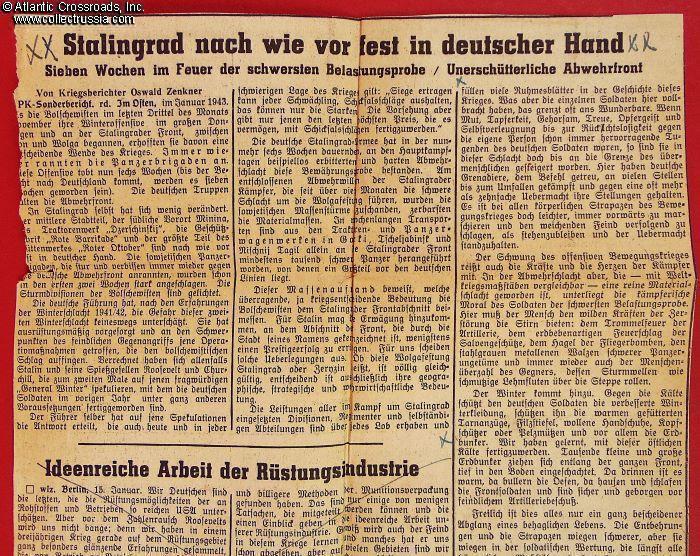
The division was re-established in February 1943 in Brittany from recovered soldiers and replacement troops but Gefreiter Rembert Viehoff was not among them. The newspaper article sent to Viehoff in the letter stamped 18 January 1943 is full of propagandistic bluster entitled "Stalingrad Still Firmly in German Hands." Even if the article was published on New Year's Day 1943, it was a whole week after the end of the Red Army offensive codenamed Operation Uranus which led to the encirclement of the German 6th Army, Romanian 3rd and 4th Armies, and portions of the 4th Panzer Army at Stalingrad.
1943
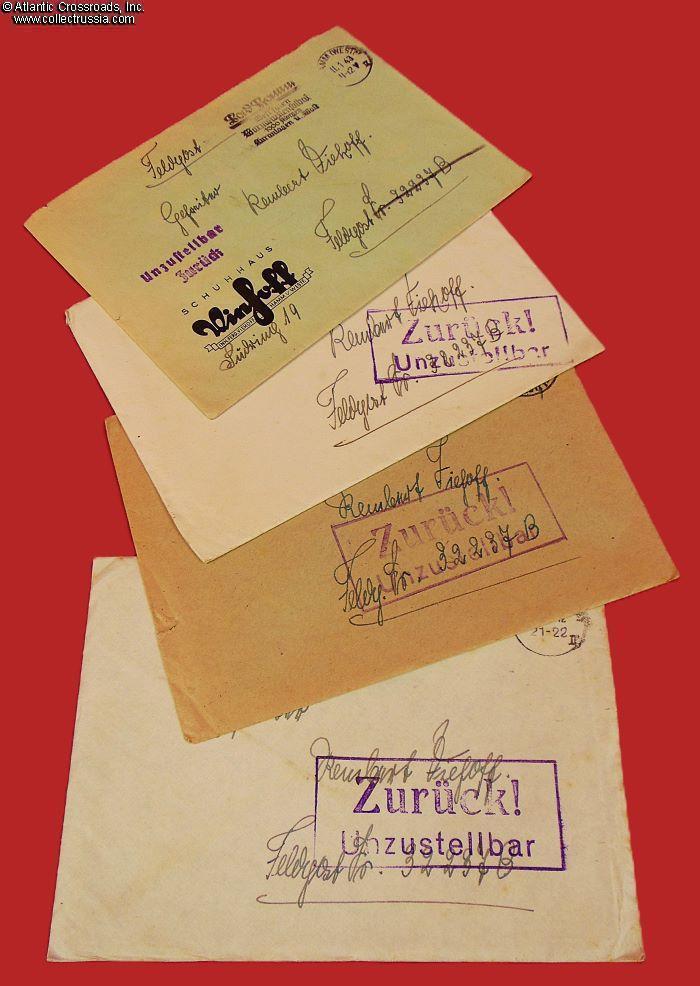
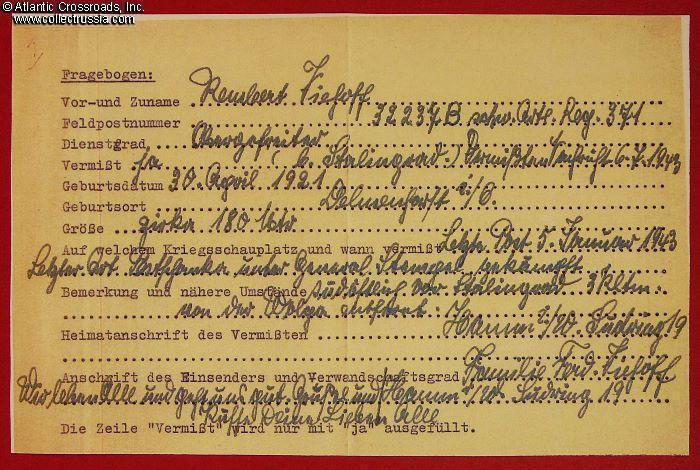
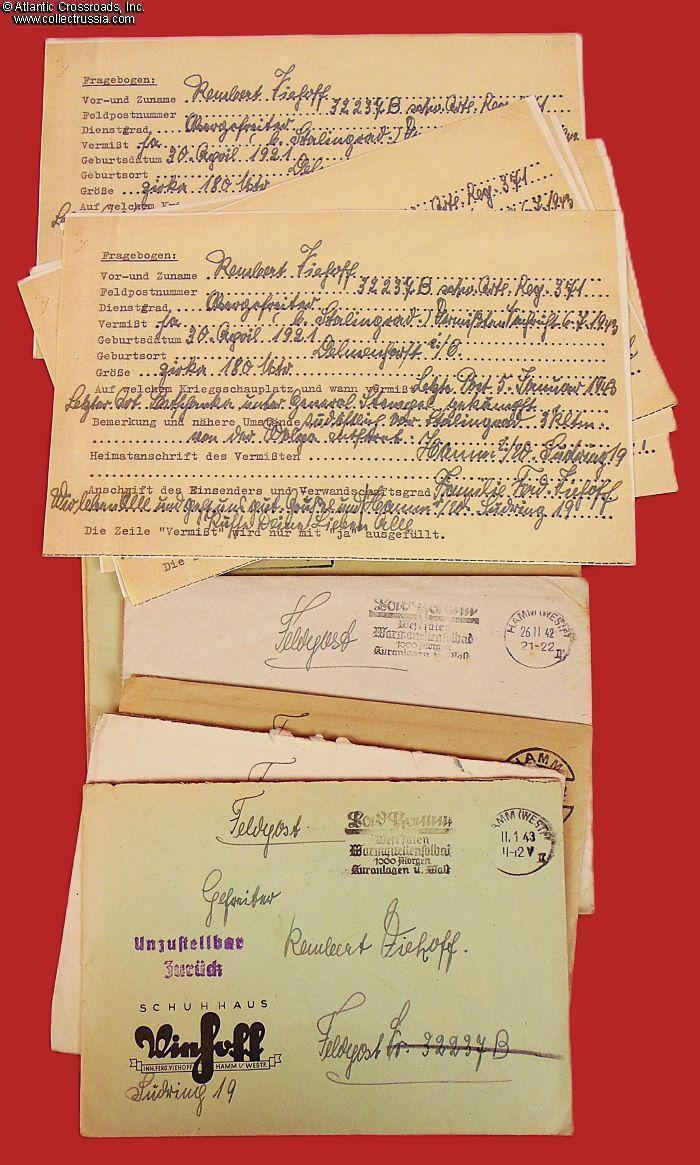
All letters to Rembert Viehoff postmarked 26 November 1942 to 18 January 1943 were written by Elisabeth Viehoff, probably Rembert's mother. All came back stamped "unzustellbar zuruck" (undeliverable, return). We have six copies of the official inquiry for a missing-in-action person, filled out in Elisabeth's distinctive handwriting. It states her son's name, field post number, rank, date of birth, and height. In the field "on which battlefield and when did they go missing," she wrote "last mail was 5 January 1943." Two more letters, postmarked 17 June and 9 July 1943 were sent to Elisabeth by her son's old friend and Stalingrad survivor Helmut Drechsler. Unfortunately, his handwriting is too flowing to make out anything but the word "Stalingrad" but it not difficult to guess what was in those letters.
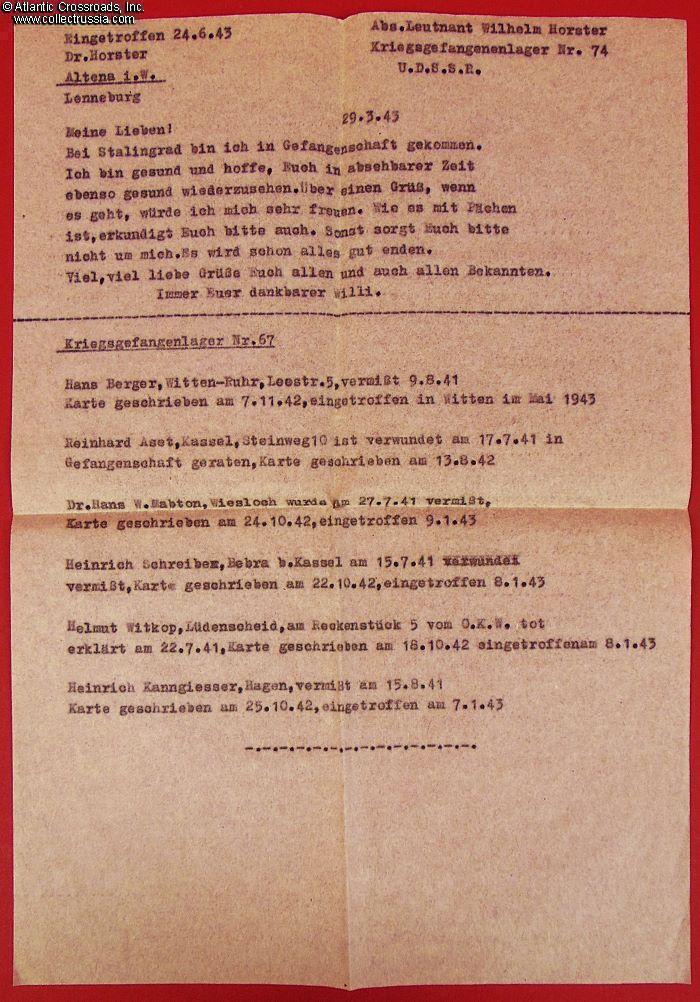
We also have a very unusual typewritten document made by Dr. Horster, father of Lt. Wilhelm Horster, who was held in captivity in the Soviet POW Camp #74. It starts with Wilhelm's transcribed letter of 29 March 1943 which says the following: "29 March '43. My Dears! I have been captured at Stalingrad. I am healthy and hope to see you again in the foreseeable future and in good health. I would be very happy to receive a word from you. Please also inquire about Pachen. Otherwise, please don't worry about me. Everything will end well. Warmest greetings to you all and all our acquaintances. Always your grateful Willi." Following this transcribed letter, Dr. Horster typed a list entitled "POW Camp #67." Note that this is not the camp where his son was incarcerated. It appears that Dr. Horster appreciated the level of grief and misery a soldier missing in action caused to his family, and tried to provide some information for the families. The list consists of six names, their home address, date they were missing, dates when "the card" (official MIA notice?) was written and received. Actually, one of the six, Helmut Witkop, was KIA.
All the items in the collection are in excellent condition.
$1,200.00 Add to cart